
is years away, not months
The June panel for the Ag Economists Monthly Monitor reports the ag economy is in a holding pattern with a hard floor. Just 19% expect crop agriculture to reach broadly profitable margins within 12 months, and half say it will take three to five years. The Ag Economy Index, which is a composite of three recurring questions asked of the panel every month, slipped to a neutral 50 — down from 61 in May — as the weaker read versus a year ago outweighed a brighter 12-month outlook. Meanwhile, the threat of New World screwworm has the panel split on USDA's response and backing a border reopening only with enhanced protocols.

Key Takeaways from the June Panel
A holding pattern — with no quick exit.
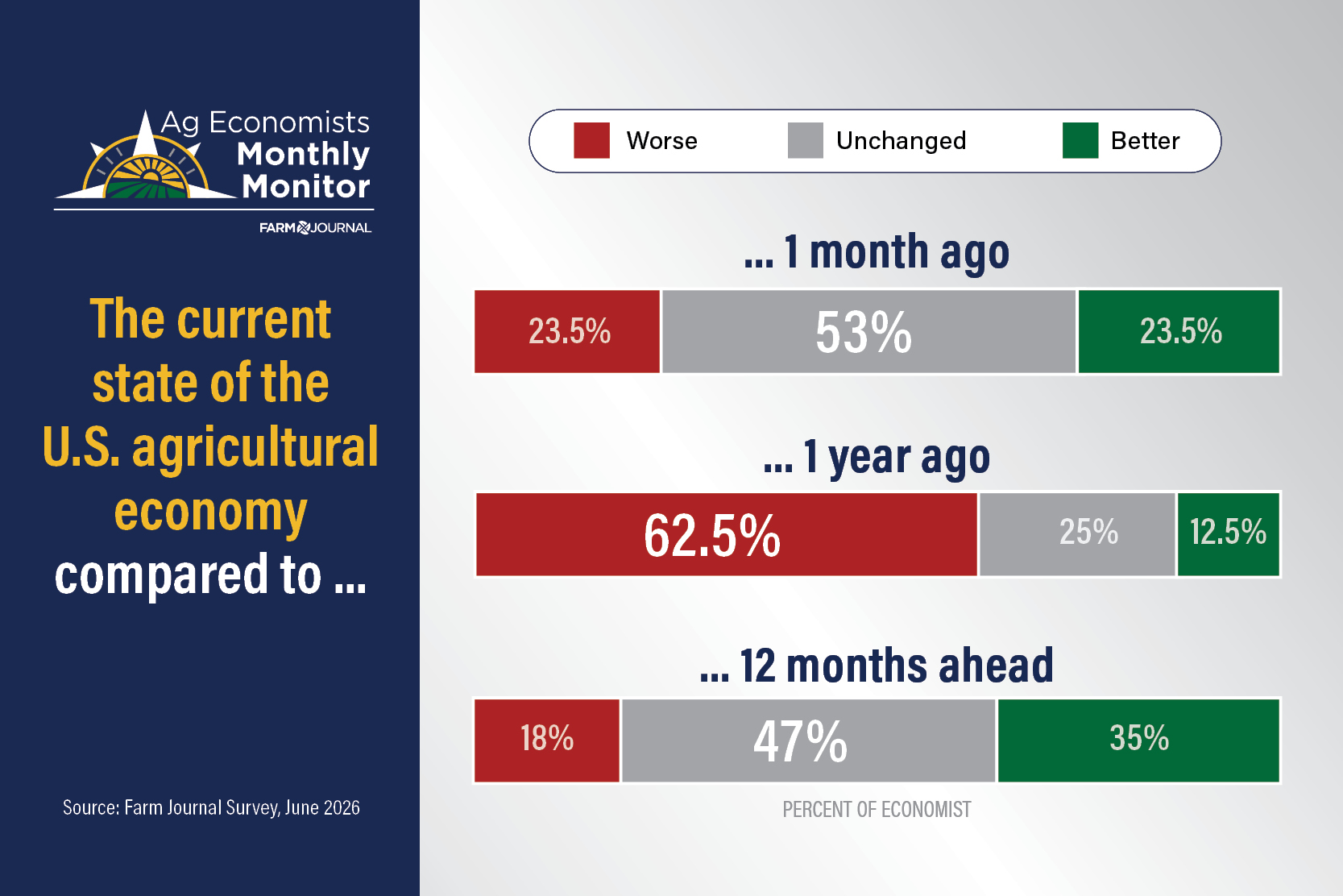
Asked when crop agriculture returns to broadly profitable margins, half say it will be three to five years, 31% say it will remain highly variable and 19% expect one to two years. The near-term read is mixed: equal shares call conditions better and worse than a month ago, 63% still see the economy worse than a year ago and almost 65% expect unchanged or somewhat worse off conditions.
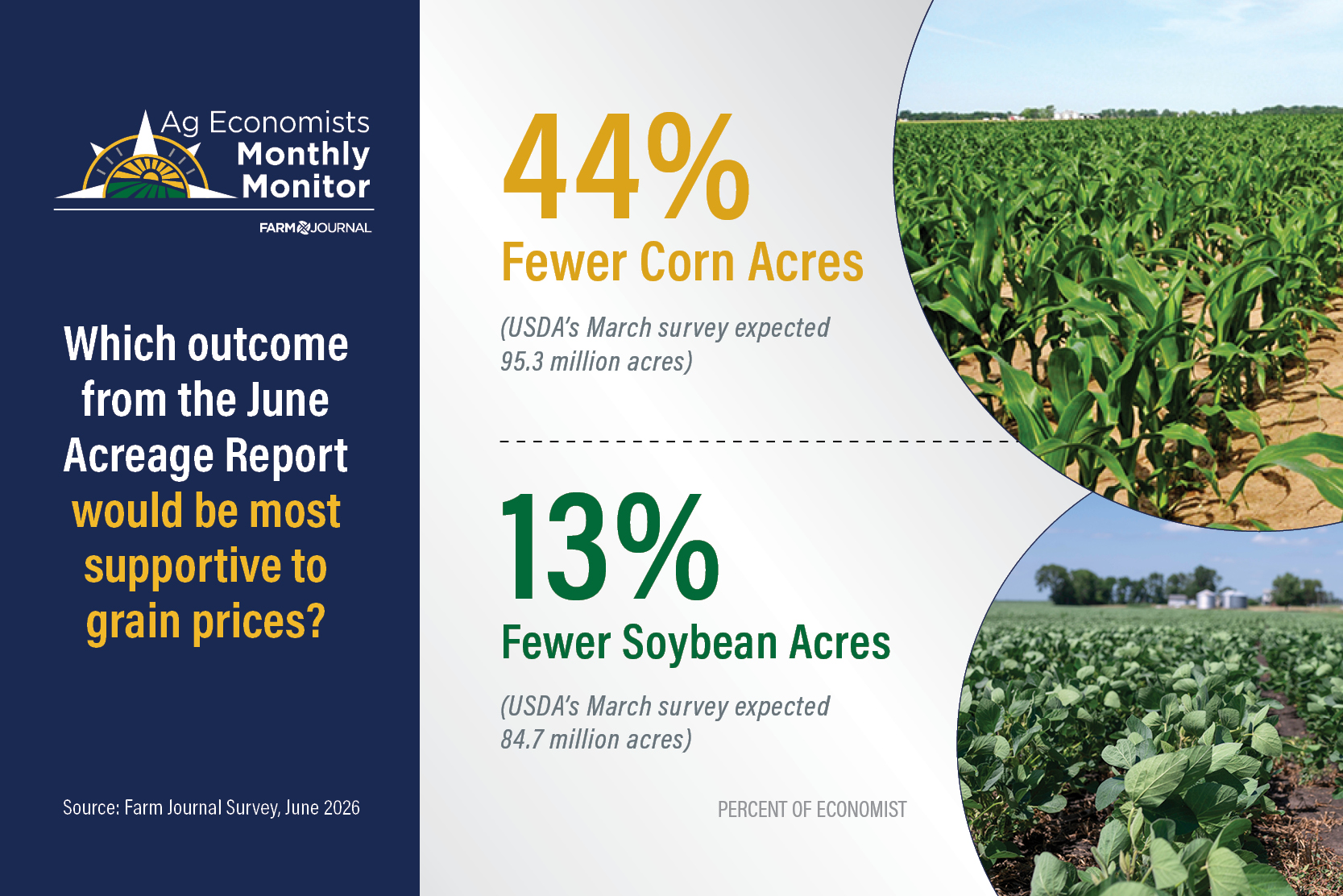
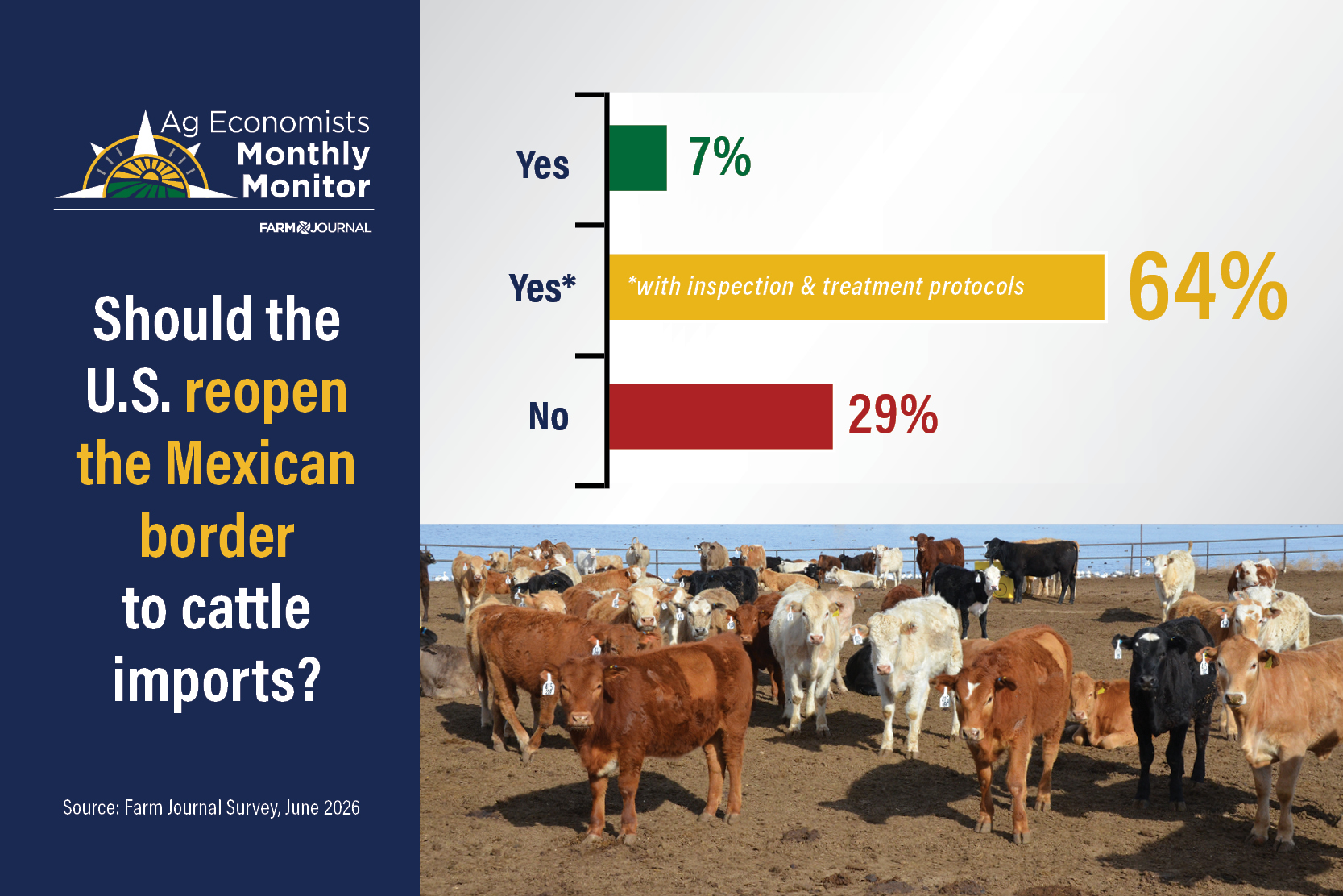
When it comes to New World screwworm, half the panel expects a moderate hit to the cattle industry if the outbreak expands and two-thirds would reopen the Mexican cattle border only with enhanced protocols. Drought ranks as the top threat to herd profitability. On crops, 60% says producers planted "somewhat too many" corn and soybean acres in 2026, while 40% say it's about right at 180 million.
The June reading cooled to 50
Each bar shows how that tracking question nets out on a 0–100 scale where 50 is neutral — the share of economists calling conditions better minus those calling them worse. The headline reading is the report's monthly composite.
Factors driving agriculture's next 12 months
Input costs & the energy shock
Export demand & U.S. crop production
The state of the U.S. ag economy
Evenly split — 24% better, 24% worse
63% say worse than a year ago
82% expect a better year ahead
When does crop agriculture return to profitable margins?
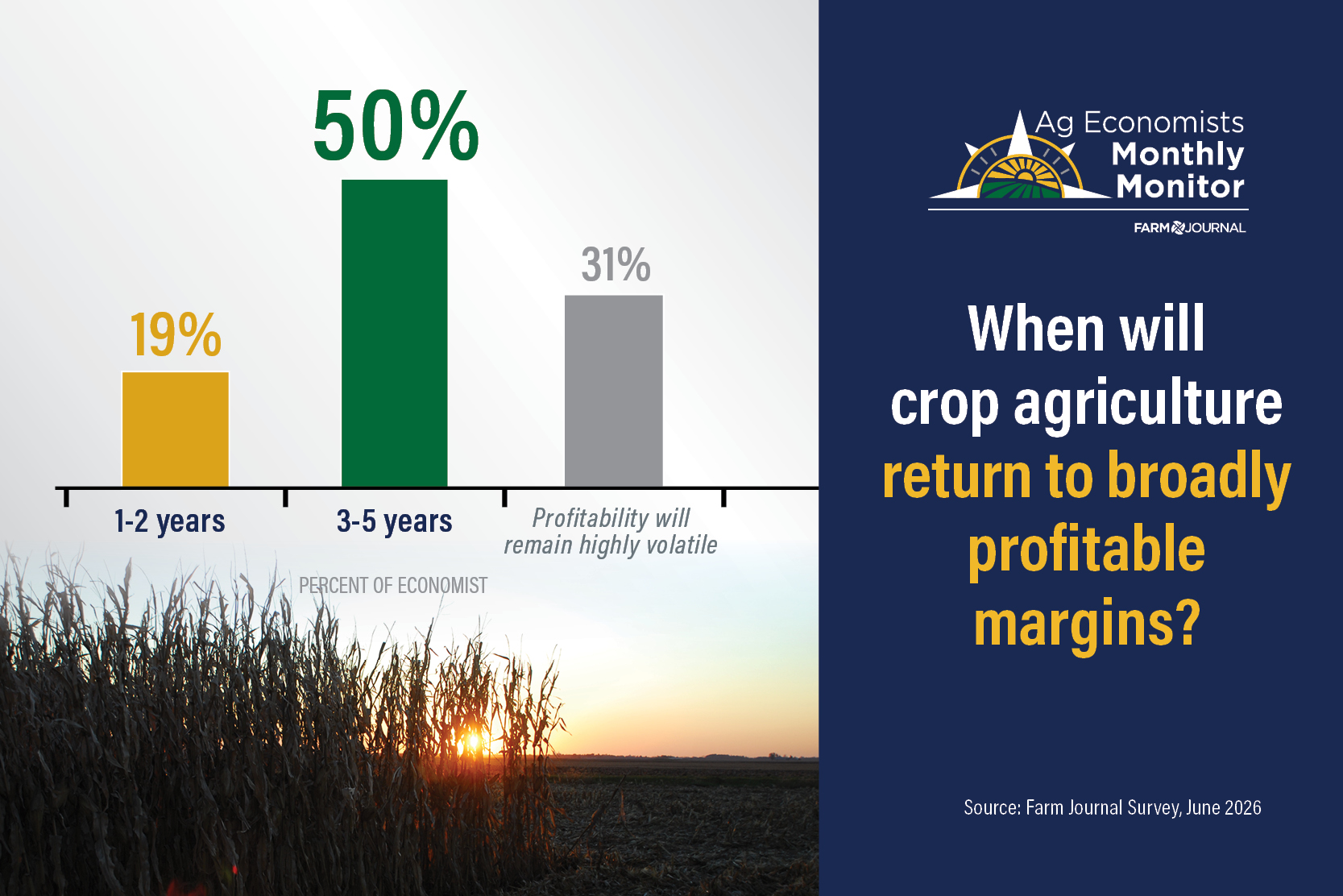
Half say profitable margins are 3 to 5 years out.
A clear majority — 50% — put the return to broadly profitable margins three to five years away. Another 31% say profitability will remain highly variable, and just 19% expect a return within one to two years. Not one economist sees profitable margins within 12 months. It is the panel's bluntest statement yet that the squeeze is structural, not a passing dip.
The fastest road back runs through a supply shock
In AgWeb's coverage, economists broadly agree the quickest return to stronger margins would come from a supply-driven event — lower acreage or a weather-related yield shortfall — rather than a demand surge, given how inelastic commodity prices are.
The safety net is doing the heavy lifting.
Direct government farm program payments are forecast at $44.3 billion this year — roughly $13.8 billion above the prior year. Without them, economists say, the ag economic picture would look materially worse.
A new threat moves onto the cattle radar
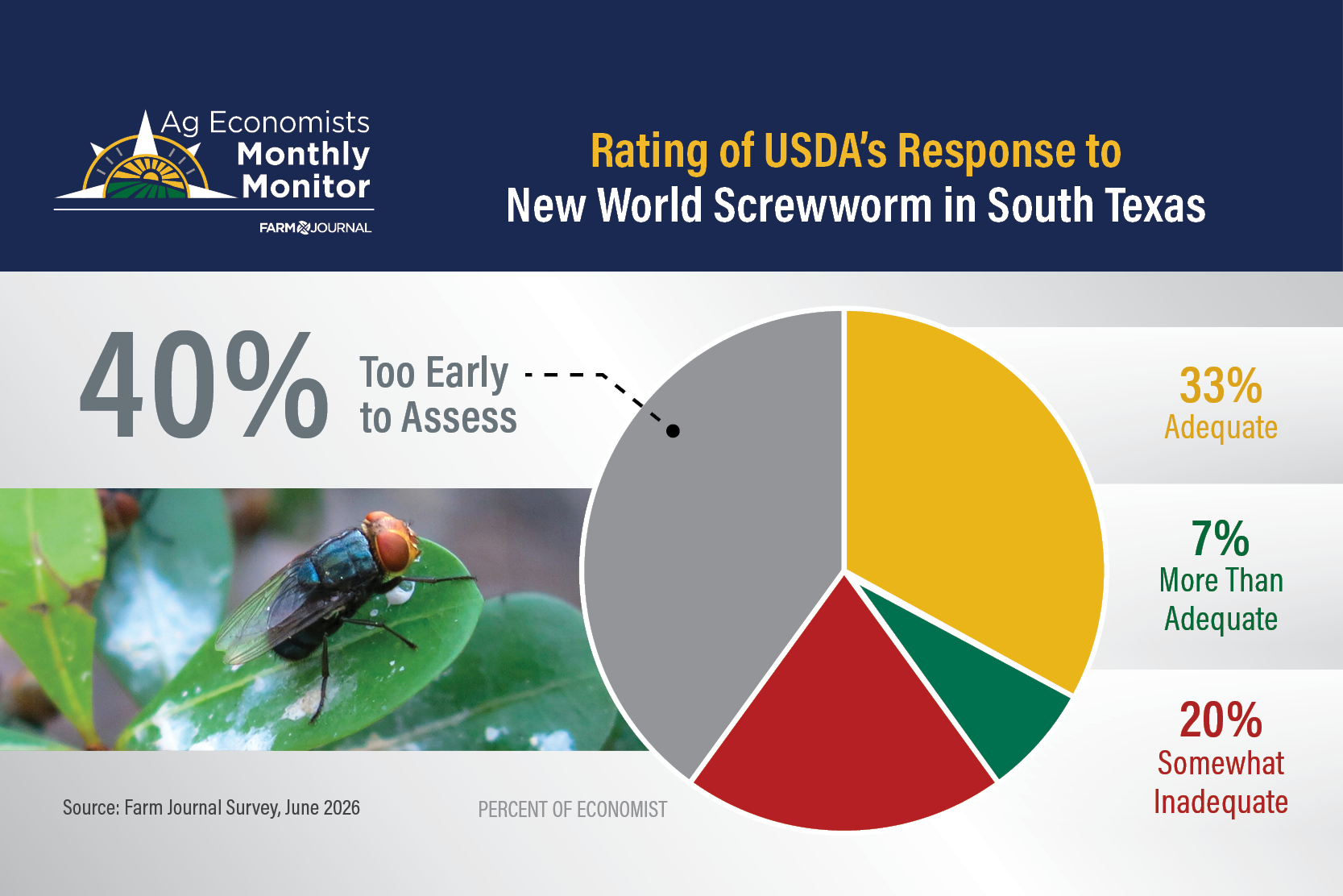
With New World screwworm now detected in the U.S., the June panel weighed its economic stakes for the cattle industry — how severe an expanded outbreak could be, whether USDA's South Texas response is adequate and whether the border should reopen to Mexican cattle imports.
A case was confirmed near La Pryor, Texas on June 3; by June 30, 27 cases had been confirmed across Texas and New Mexico. Feeder cattle futures fell more than $5/cwt the day of the announcement, then rebounded the next — with no detectable hit to the cash market. Most economists say the news was already priced in.
A moderate hit — not yet a catastrophe.
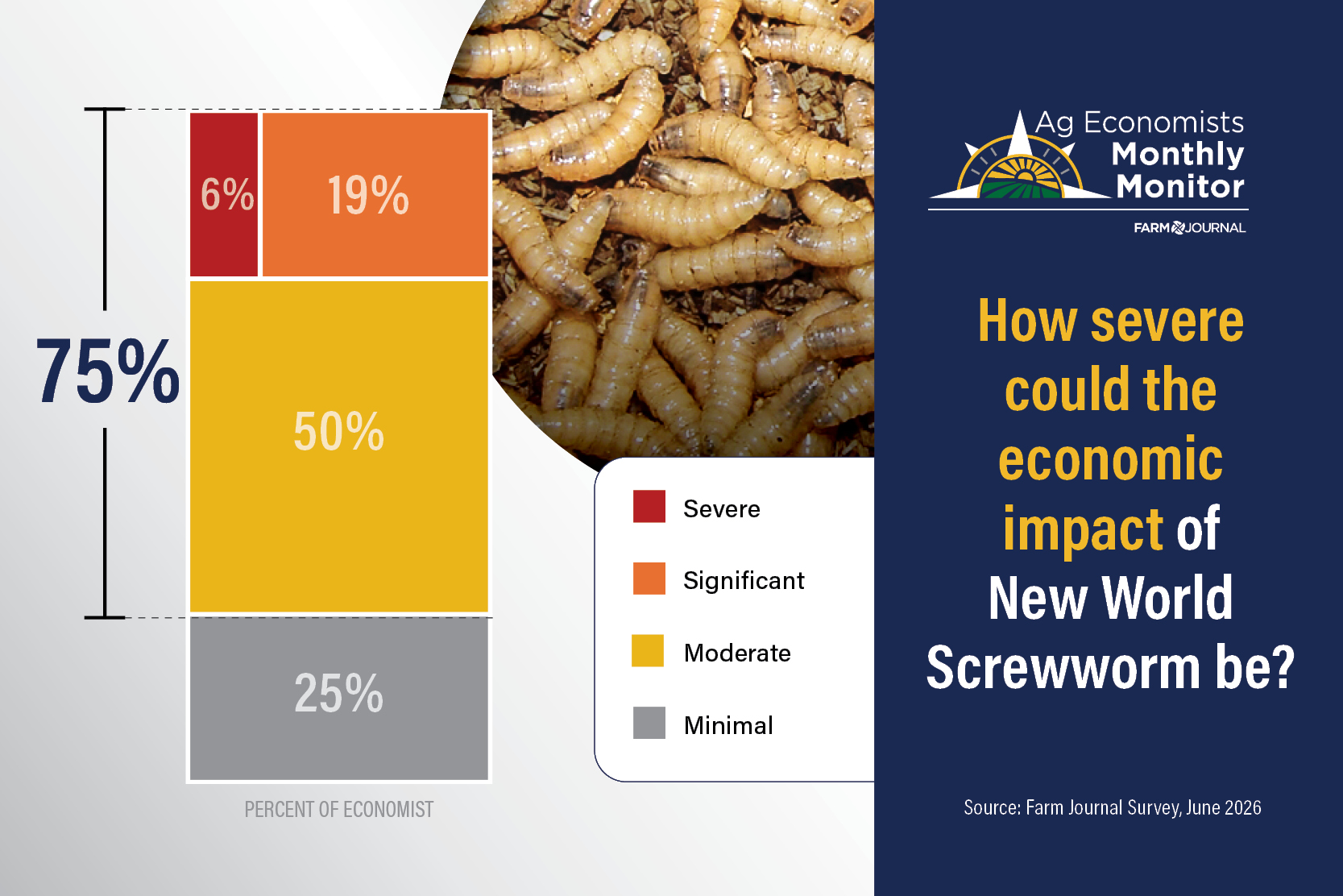
Half the panel expect a moderate economic impact on the U.S. cattle industry if screwworm spreads beyond its current footprint, and a quarter call it minimal. Roughly one in five flag a significant blow, and just 6% see a severe outcome — none called it catastrophic. Taken together, three in four — 75% — foresee at least a moderate hit if it spreads: high concern, tempered by a belief the threat is manageable if contained.
Verdict withheld — 40% say it's too early
Yes — but only with enhanced protocols
What threatens cattle profitability most
Asked to rank eight threats to the sustainability and profitability of the U.S. cattle industry, the panel placed weather and beef demand far ahead of emerging pests. Bars show relative priority — longer means a higher-ranked threat.
Did farmers plant too many corn & soybean acres?
60% say 2026 corn and soybean acres are "somewhat too many."
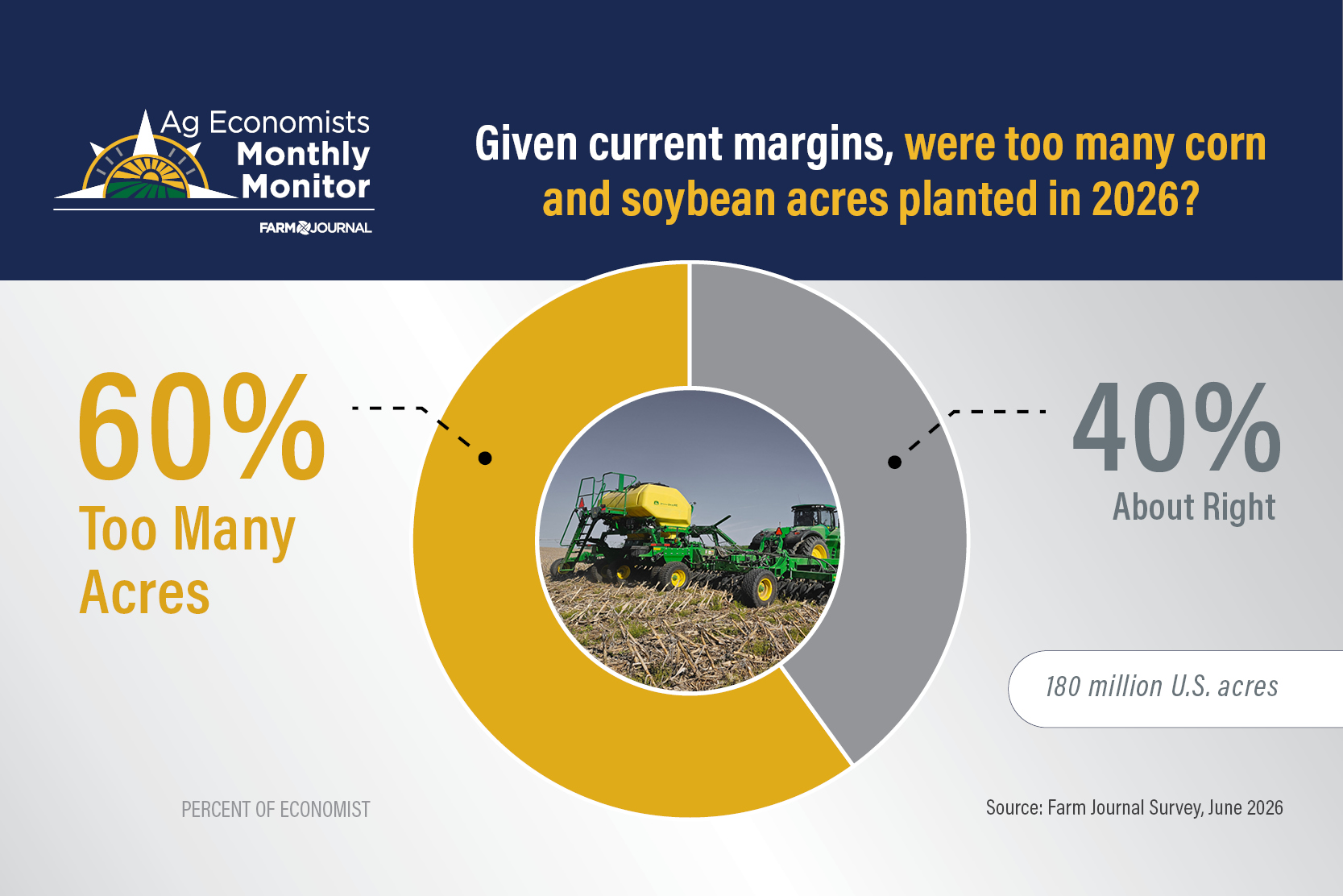
Ahead of USDA's June Acreage Report, 60% of the panel say U.S. farmers planted "somewhat too many" corn and soybean acres at 180 million, while 40% say that's about right. Not one economist said producers planted too few. Even a right-sized crop keeps margins tight, with prices still below the cost of production for most.
The one indicator each economist is watching
Farm Debt/Asset ratios are key, but farmers are inherently asset rich and thus changes are often masked. Thus I turn to crop margins.
The spike in fuel prices impacting variable costs and profitability was an exogenous shock that producers could account for.
If farmers aren't paying off loans that will lead to savings and loans stress, less lending and more foreclosures.
Although it is a bit like putting Humpty Dumpty back together, we need a deal with China.
Stable land values are extremely important to balance sheet strength.
Many economic indicators are lagging, especially from a national data perspective. Input costs like fertilizer and fuel can be tracked in real time and used to estimate impact on indicators like net farm income.
About the Ag Economist Monthly Monitor
The Ag Economists Monthly Monitor is administered by Farm Journal and published on AgWeb. Each survey is administered to a vetted list of agricultural economists from across the United States.
Three of those questions repeat every survey, so changes can be tracked over time: current conditions vs. the prior month, current conditions vs. a year ago and the panel's outlook for the next twelve months. The trend chart plots those three categories. The composite sentiment index is a rebase of the four response shares to a single 0–100 number.
Responses are anonymous. Economists give the unvarnished view they cannot always offer with their name attached, and the panel composition is broad enough to cover crop, livestock, policy and ag finance perspectives. Reporting and analysis are produced by the AgWeb editorial team and overviews are aired on AgDay, AgriTalk and U.S. Farm Report.
Ask our editors a question
Have a question about the report findings? Send it straight to our editorial team. Are you an agricultural economist? Tell us if you’d like to be considered for future survey panels.