


A bold, new era marked by mass adoption of autonomous machines is nearing realization. Farmers are more interested than ever in the shift to full automation.
Ohio State University professor John Fulton points to the current farm economy as one catalyst driving interest. He believes challenges in recruiting skilled labor and an increasing comfort with technology will continue to advance buy-in from growers.
“You’re going to see more of it being embedded into machines, and we’re right on the cusp of seeing more autonomy adopted by farmers,” Fulton says.
Let’s dive in and explore what some companies developing autonomous solutions have been working on.
Retrofitting Robotics
Sabanto is developing retrofit kits to convert existing tractors into autonomous machines. The approach is grounded in founder and CEO Craig Rupp’s belief the next generation of highly capable, high horsepower tractors – what he deems the “Swiss Army Knives” of farming – are already in farmers’ machine sheds.
Rupp says rather than buying a new tractor with the latest autonomy features, farmers should first explore upgrading their current machines. Installation of Sabanto’s retrofit autonomous tractor kit is available today on John Deere’s 5E and 6E Series, as well as Kubota and Fendt models.
Sabanto is focusing on integrating farmer feedback into its autonomous tractor kits.
One potential low-hanging fruit is autonomous field-to-field traversal. This would shuttle the tractors autonomously between fields connected by a private drive, and someday do the same on public roads. Autonomous machines today are trailered from field to field.

Sabanto is also forming a team of virtual field operators, made up of young people with experience in farming simulators, Rupp says. These operators will remotely oversee and control Sabanto machines across the country. After a farmer trailers a tractor to a field and unloads it, the virtual operators will manage tasks and oversee in-field operations in real time.
Rupp says Sabanto engineers are also improving in-field path planning and extending active hours with the goal of running robotic tractors around the clock.
From his viewpoint, the former electrical engineer turned ag entrepreneur is convinced autonomous farming will happen at a large-scale.
“We’ve gone beyond the when and if, and we’re at the stage where it comes down to how it is going to be done,” Rupp says.
2030 or Bust?
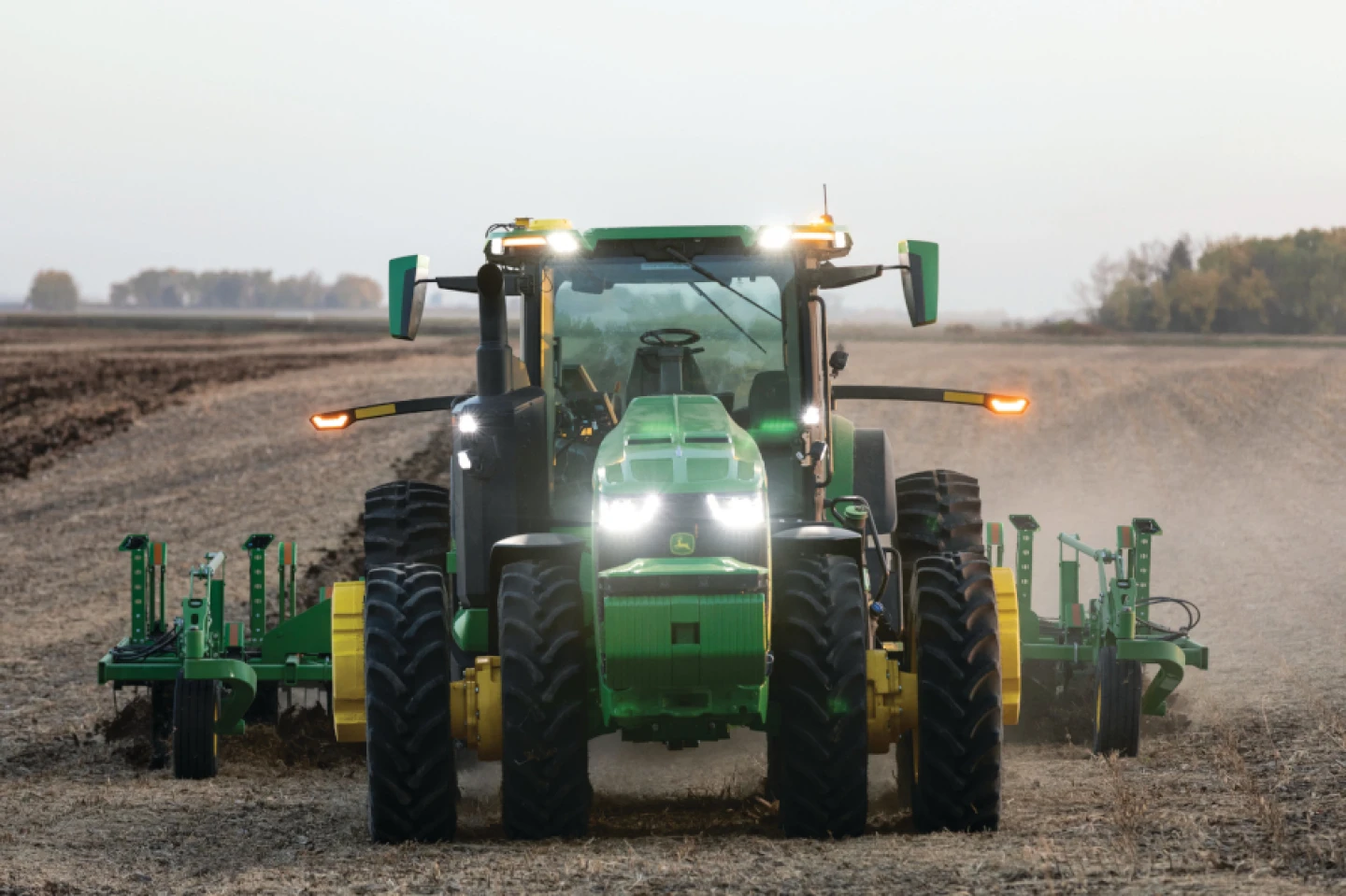
John Deere’s transition from equipment manufacturer to data and ag tech innovator plows ahead at full steam. The manufacturers’ model year 2025 class of machines showcased more factory-installed autonomy features than any previous class in its long history.
A recent key development is the release of John Deere autonomy-ready packages for its tractors and tillage tools. The aftermarket kits include all of the necessary hardware and safety features for autonomous operations. To unlock full autonomy, farmers will only need to add a perception system, which consists of cameras and vision processing units.
In the future, Michael Porter, go-to-market manager – large tractors, says the perception system will be available alongside its retrofit precision ag technology kits through John Deere’s Precision Upgrades program.
“These elements are a key step in preparing farms for autonomous operations, and making those tools available [aftermarket] demonstrates the commitment we have to helping farmers at every phase along the autonomous journey,” Porter adds.
John Deere’s runway to bringing its machines to life without an operator at the helm is short: The company is in a race against the calendar, having pledged to delivering a fully autonomous fleet of machines in corn and soybeans by 2030.
The next opportunity to learn what John Deere is planning for its row-crop technology stack looks to be the Consumer Electronics Show (CES) in Las Vegas, Nevada, in January 2025. Last year, the company showcased its 8R autonomous tractor and Furrow Vision seed furrow sensing technology.
Specialty Crop Starting Line
CNH-owned New Holland recently announced a tie up with ag robotics startup Bluewhite. The partnership will enable collaboration on distribution, manufacturing and integration of Bluewhite’s autonomous technology with New Holland tractors in North America.
According to Paul Welbig, director of precision technology, New Holland, the Bluewhite kits consist of many common components, such as front-facing LiDAR and various arrays of connected sensors around the tractor. Cursory mechanical drive components, as well as software to link everything up and make it all “talk”, or work in concert, are also included.
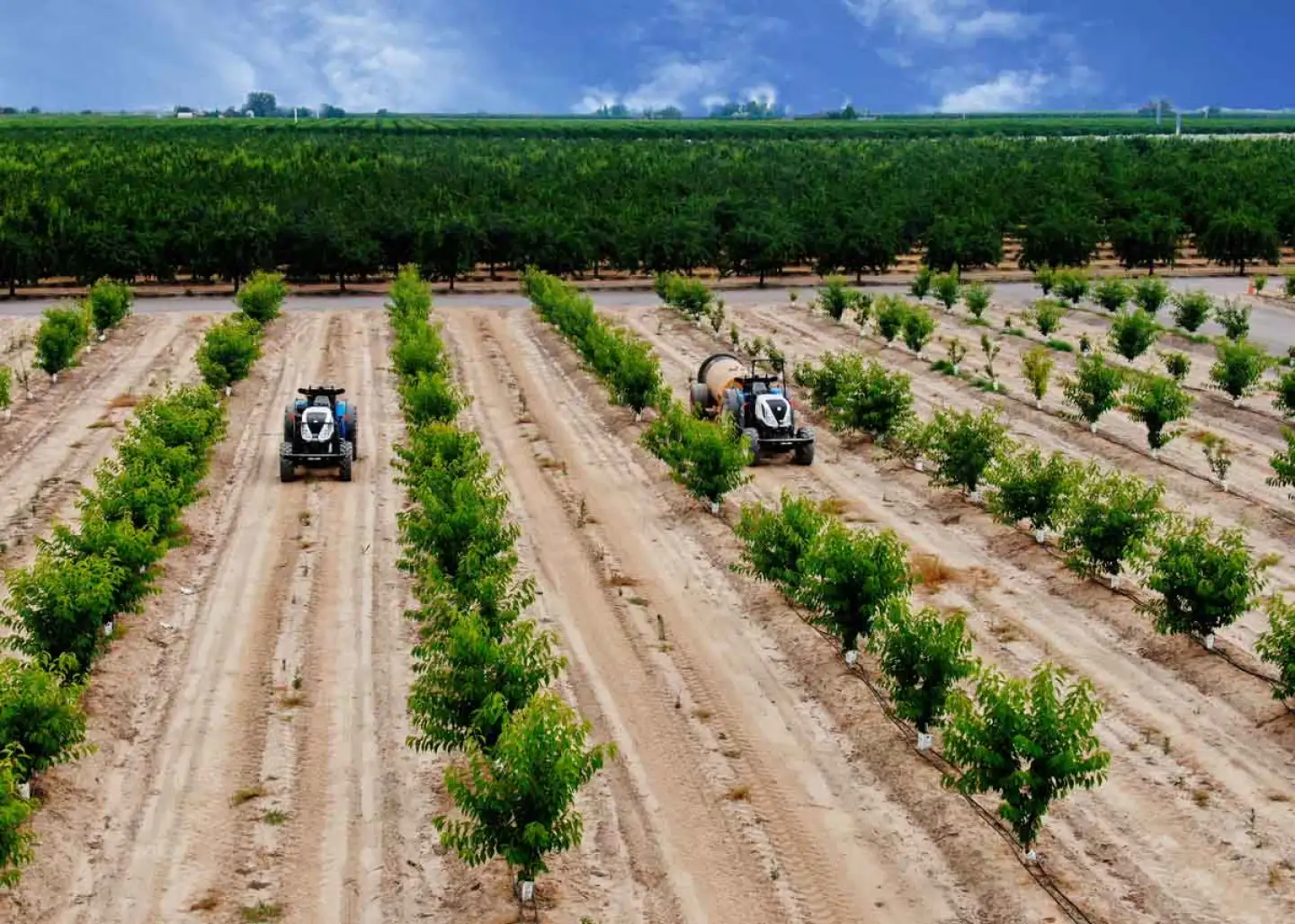
New Holland has also started building out its autonomy portfolio in row crops, starting with its driverless grain cart technology, Raven Cart Automation, that links up a grain cart (pulled by a tractor) and combine autonomously, removing the need for an additional driver during harvest.
“The practicality and return on investment [for that system] come in when you run more than one machine with only one operator,” Welbig explains. “That’s really how you start to see value; we can support multiple combine and tractor combinations – up to six machines total – today.”
Welbig and the New Holland executive team see autonomy as a five-step journey. The first step is auto guidance and GPS, and step two is ensuring all machines are connected and exchanging data. The highest level of autonomy, step five, represents a complete removal of both the driver and the farmer from the field altogether. At that level the farmer sits in a central location, managing and tasking multiple machines from a computer or tablet.
“Steps two, three and four in between, there’s still a lot of meat left on that bone,” Welbig admits. “As autonomous technology continues to evolve in the future, we’ll continue to evolve with it.”
Fully Cycle Autonomy
AGCO’s newest joint tech venture, PTx Trimble, is now solidly off the ground, and the company is advancing its autonomous grain cart tech heading into 2025.
The group’s vision of bringing autonomy to the full ag production cycle is also coming to life, although like its competitors, it’s going to take time for the full vision to come to fruition.
PTx Trimble’s automated grain cart system, OutRun.ag, will be available for purchase in 2025. For year one, single cart configuration is unlocked. The next evolution is enabling swarming of two autonomous grain carts around the same combine.
PTx Trimble also has an autonomous tillage system currently in development. The company figures many farmers will happily give up running a tillage tool across the field to a robot.
A clear differentiation point is PTx Trimble’s use of cellular connectivity and edge computing over low orbit satellite connectivity. This allows for operation in remote areas with sub-par connectivity.
RELATED: Planting A Flag: AGCO All-In On Mixed-Fleet Aftermarket Ag Tech
One limiting factor to adoption is farmer sentiment toward field work, and the types of tasks they’ll agree to give up to a machine. Ultimately, it will be up to the technology to fully prove its worth.
“As you automate you have the option of pulling the operator out [of the cab],” says Eric Hansotia, AGCO CEO. “But where is the farmer going to feel comfortable giving up that control? And can we find an autonomous solution there and build up farmer trust?”
Your Next Read: Making Purchases for 2025: All You Can Do Is Your Best!



