

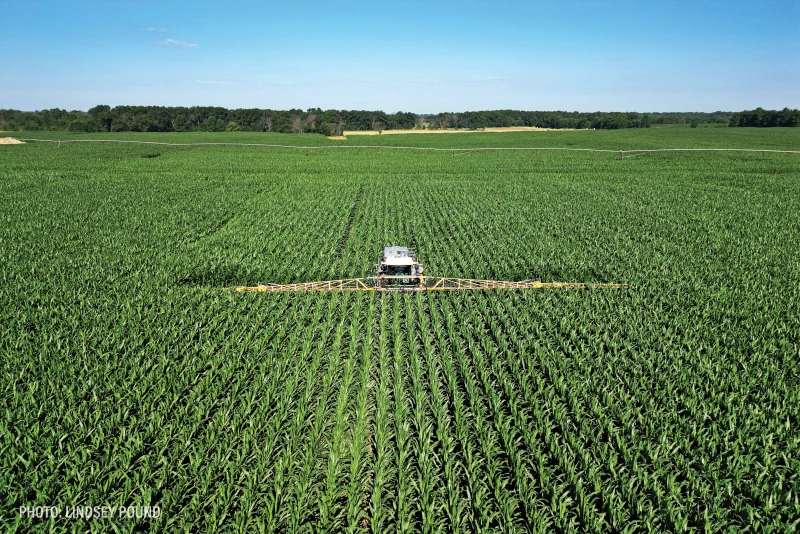
Beyond “How much do I apply?” growers need to ask “When can my corn actually use it?” says Connor Sible, a crop physiologist at the University of Illinois. Sible and Fred Below’s research shows dialing in the timing and placement of nitrogen (N) and phosphorus (P) applications can be the difference between a 160-bu. crop and a 230-bu. or even 300-bu. one.
“The key is peak uptake. Your crop doesn’t need the same amount of nutrients every day. There’s a short window when demand spikes, and that’s what really drives yield,” Sible noted during the 2026 Crop Management Conference.
Here are four ways Sible and Below say corn growers can use that insight in the field this season.

1. Build A Plan to Meet Peak Demand.
High-yield corn doesn’t consume nutrients at a steady, linear pace, according to Below. His research indicates that a 230-bu. crop can pull more than 2 lb. of P₂O₅ per acre per day during peak demand. N demand is even more intense, reaching 5 lb. to 9 lb. per acre per day.
He encourages high-yield farmers to shift their mindset from total seasonal pounds to daily availability. For example, growers hitting the 230-bu. mark typically:
- Use realistic yield goals and removal charts to calculate total needs.
- Overlay uptake curves provided by agronomists or seedsmen to identify the exact window of peak demand for specific hybrids.
- Target the window and build fertilizer plans to meet that two- to three-week peak demand period.

2. Place Phosphorus Where Roots Can Reach It.
Phosphorus is notoriously immobile in the soil, relying on root interception to be absorbed. This makes placement a critical timing tool.
To support peak demand, Sible and Below suggest banding P under the row. The goal is to create a vertical column of phosphorus that corn roots naturally penetrate exactly when demand spikes. This results in the nutrient being in the path of the growing plant rather than scattered throughout the soil profile.

3. Use Split Nitrogen Applications to Cover the Surge.
To ensure N is present and accessible during the midseason surge, high-yield growers are increasingly moving toward split applications.
Sible notes a common successful strategy includes a preplant base followed by a sidedress application between V5 and V8. This can be achieved via knife, coulter or injection, often supplemented by Y-drops or high-clearance applications near tassel in some cases.
This strategy serves three purposes:
- Reduces the time N sits in the field before the crop needs it.
- Replenishes the root zone as demand ramps up.
- Maintains the necessary 5 lb. to 9 lb. of daily available N during the fastest growth stages.

4. Protect Uptake With Soil Health And Residue Management.
Corn growers aiming for high yields can support peak nutrient uptake in corn by fostering soils that mineralize nutrients naturally. Sible points out that while fertilizer covers the shortfalls, the soil provides the baseline.
“High-yield growers keep residue managed, via strip-till or strategic tillage, so microbes can break it down and release N, P and S over time,” Sible says. “They also maintain or build organic matter, which feeds the mineralization engine that kicks in as soils warm into early summer.”
This “mineralization engine” provides a steady background flow of nutrients, Sible adds, allowing supplemental fertilizer and precision placement to push the crop through its highest-demand hurdles.



