

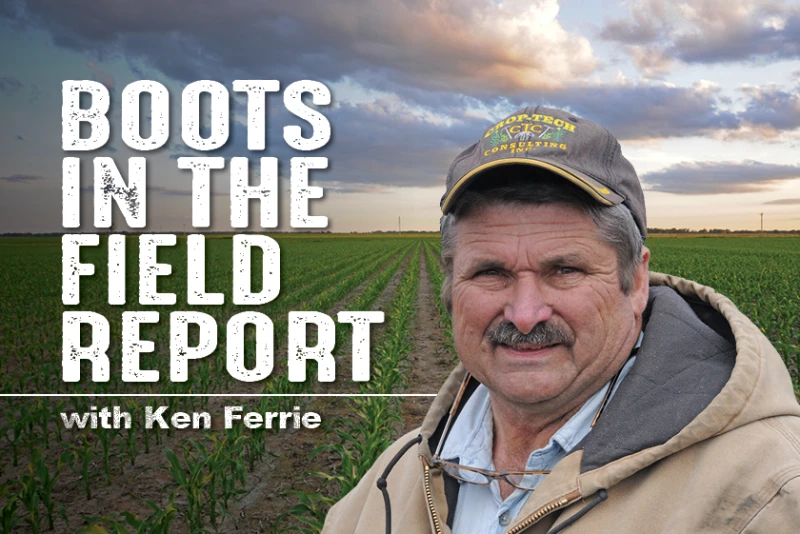
A lot of water showed up this week in parts of Illinois, with reports ranging from 2 inches to over 6 inches of rain in some areas. Some of it fell so quickly and hard it caused soil erosion issues. Along with that, Ken Ferrie says there is now a lot of water that has ponded in cornfields.
Concerned farmers are calling him and asking how long they can expect their corn crop can survive after being under water.
Several factors can go into the estimation, including the hybrid, seed quality and how long the corn was submerged. The most significant factor that contributes to survival is the temperature, says Ferrie, Farm Journal Field Agronomist and owner of Crop-Tech Consulting, Heyworth, Ill.
“With temperatures below 70 degrees in the day and maybe in the mid- to low 50s at night, you typically would have 48 to 96 hours – up to a four-day window – for corn to be underwater and still survive,” says Ferrie. “I’ve seen in soils at less than 50 degrees, and we haven’t had the crop germinate yet, the corn survived after being under water for 10 days.”
But when temperatures go north of 70 degrees and up into the 80s, the likelihood corn will survive drops back to more like 24 to 48 hours.
Ferrie says the likelihood water-saturated corn will survive also differs in ponded areas or areas with freeze damage.
“When we get freeze and frost damage, we have to wait to see if the crop’s going to recover before we can replant or thicken the stands up,” he says. “With ponding, by the time it’s dry enough to replant, you’ll know whether it’s dead or not.”
A Silver Lining
Typically, with ponding, Ferrie says farmers usually find a lethal kill occurred to their corn. “You don’t have to worry about thickening up stands or taking out the old ones, you just drop the planter and go,” he says.
Ferrie says farmers will likely need to address some of what he refers to as bathtub rings before any ponded areas can be replanted.
“We may have to be burning some of those rings off or figuring out what we’re going to do with them,” he says.
He recommends sending up a drone to take pictures of any ponded areas that are sitting out in low areas of fields. That can help you accomplish two things. 1. You’ll be able to estimate the amount of replant seed that’s going to be needed. 2. The drone pictures will guide you or a pest scout on where to go in the field when you’re ready to evaluate corn stands.
“We don’t want to miss these and find an area when we’re out there sidedressing knee-high corn and think, ‘man, we should have replanted this,’” Ferrie says.
Before getting hung up on ponding concerns, Ferrie advises farmers to get their entire crop planted before worrying about how to them.
“I’m not so worried about the replanting of ponds,” he says. “They’ll either make it or they’ll need to be replanted. But I am concerned about the other acres that got smacked in in some of these areas with the heavy rain events.”
Get The Hoe Ready
Another concern he mentions is that saturated soils can go from being wet to being crusted over quickly.
“Guys, if you don’t have a hoe now is the time to start looking for one,” he says. And if you’re in doubt about whether you should hoe or not hoe, as we say here – hoe before you know. You guys know which soil types on which farms give you the most trouble.
“Let’s not wait to see if the beans or corn are going to get into trouble before we hoe. If you’re one of those guys who believes the hoe never does you any good. You’re getting there too late, the crust is too hard,” Ferrie adds.
Stay On Top Of Weeds
Rain kept many farmers from being able to apply their preemergence herbicide. Others were unable to kill their cover crops after planting and prior to the rains. What to do in those scenarios? Ferrie says you’ll need to go into fields by air and spray them.
Along with that, another weed issue is winter annuals that get dense enough that they cause issues once farmers want to run their field cultivators.
“If the fields are unobstructed and you can get airplanes into them, airplanes can do a great job of cleaning these fields up,” Ferrie says.
In some scenarios, a spray drone can also provide weed-control support.
“With the drone, you may have to go in there and touch up your edges and around your waterways, but these are some good options to keep moving forward on the herbicide front as we’re dealing with these wet conditions,” Ferrie says.
Moisture levels are also impacting farmers efforts to control pests and disease. Ferrie says wheat acres need to be scouted for disease, because of the excess moisture.
“This, too, is a good place to go in by air in wet conditions so we’re not wiping out that wheat in the wheel tracks of our sprayer,” he says.
Three other brief recommendations:
1. Scout alfalfa fields for weevils, as they’re showing up in areas of fields with standing water.
2. Beware nitrogen loss to denitrification.
3. Use drone pictures to identify areas where nitrate tests need to be pulled to check for N loss, which can help guide any sidedress decisions.
Get Ferrie’s complete report, and additional insights, in the following articles and this week’s Boots In The Field podcast here:
Ken Ferrie: 7 Tips To Overcome Moisture Concerns At Corn Planting
How to Calculate Growing Degree Days (Simple Formula)
Seed Technology and Evolving Farming Practices Win Against Drought’s Grip
3 Tips For Better Weed-Control Outcomes This Season



