

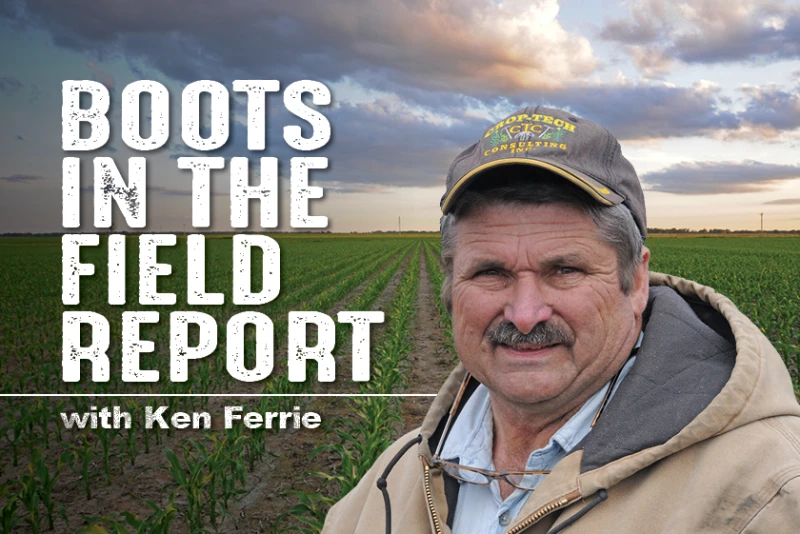
A soaking rain has pulled much of the Midwest out of drought, but it’s also put the brakes on corn planting just as a cold snap settles in, says Ken Ferrie, Farm Journal Field Agronomist.
Ferrie explains that recent storms dropped anywhere from a half inch to 4” of rain across farmers’ fields and, with it, erased lingering drought stress and filled ponds that “will probably stick around a while.” The moisture, however, has saturated soils to the point that most of his planting “signal lights” for corn are now red.
“Due to wet conditions, most everyone is red at this point, and that doesn’t change until the soil is fit,” says Ferrie, who’s based in central Illinois. “We don’t mud in corn.”
Cold Spell Drives Conservative Corn Strategy
Ferrie bases his current recommendations on the close agreement between the Global Forecast System (GFS) and European weather models through May 9, both of which point to a stretch of cold conditions unfavorable for corn establishment.
“When they’re close together, the accuracy is usually higher and they both indicate a cold spell,” he says.
With that outlook, he’s cautioning growers across multiple regions to be conservative on planting corn especially until temperatures and soils improve. He emphasizes that while model divergence after May 9 could change the picture, he’s focusing on the 10-day window where the models agree to set planting guidance.
“Three days is a long time in weather forecasting, but they do seem to hit the temperatures closer than the rainfall amounts,” Ferrie says. “So, we’ll reevaluate on Monday to see how this forecast changes.”
Regional “Signal Lights” For Planting Corn
Ferrie uses a green-yellow-red “signal light” system to simplify planting decisions:
- In areas around Jacksonville, Ill., and further south, conditions shift to a green light for corn starting Sunday noon, May 3, before turning more cautious midweek.
- Along the U.S. Highway 136 corridor, he calls for a yellow light on May 3, switching to red by next Wednesday noon, May 6, likely holding through May 9.
- In northern Illinois and around Iowa City, Ferrie highlights there will be rapid swings in planting opportunities as forecasts point to a seed-chilling event moving in.
- In northeast Iowa (Cresco area), Rochester, Minn., and across much of Wisconsin, the guidance is straightforward: “It’s going to be a red light until May 9,” he says.
Across all these regions, Ferrie’s advice centers on patience with corn until soils are ready and the coldest temperatures pass.

Beans Offer Opportunity—If Ground Is Fit
Even as he urges caution on planting corn, Ferrie says the forecast still allows room for farmers to progress on soybeans where field conditions permit.
“We still have a green light on beans if the ground is fit,” he says.
He urges farmers to pay close attention to seed quality and stand establishment, especially where soybeans are untreated.
“Watch your percentage germ on your tag, especially if the beans aren’t treated,” Ferrie says. “You may need to bump those populations up a little for weed control.”
Most of the “frosted off” early beans in Illinois have already been replanted or patched, he notes, but some drowned-out ponded areas will likely need follow-up patching once water levels recede.
Manage Corn Risk In The “Yellow Windows”
For growers who have not yet put any corn in the ground, Ferrie recommends using upcoming yellow-light windows to strategically manage risk — without forcing corn into marginal conditions.
“If you haven’t planted any corn yet with the planter, and to mitigate some risk, you may want to get some corn planted in these yellow windows so you’re sure that you can put the hammer down when this cold snap passes through,” he says.
That approach, he explains, helps spread risk across planting dates, while still respecting soil fitness and seedbed quality. The goal is to avoid having all corn acres exposed to the same stress event, whether it’s chilling, crusting or prolonged saturation.
Ferrie encourages growers to stay tuned for updates as the forecast evolves, noting that temperature forecasts tend to be more reliable than rainfall projections in the short term. He directs farmers to ongoing updates and deeper discussion via his team’s online and audio channels.
To stay up to date, check out Ferrie’s website at croptechinc.com and subscribe to his podcast, Boots In The Field. You can listen to it at the link below:



