

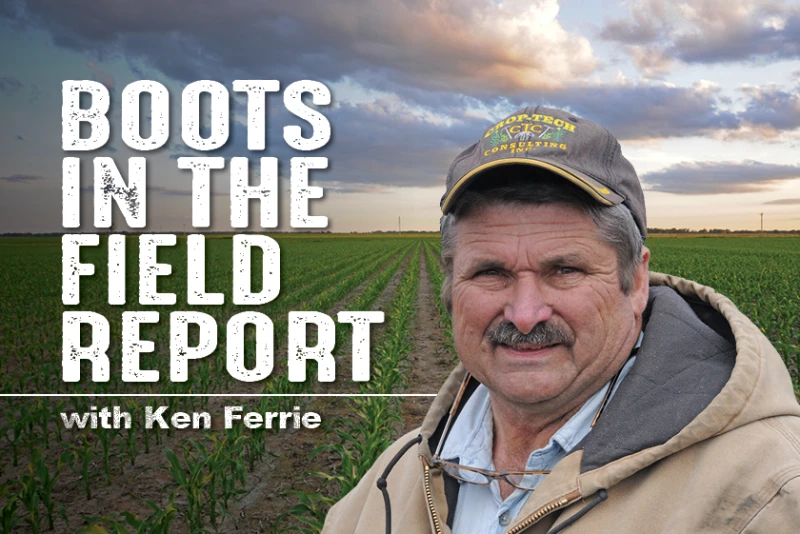
Corn and soybeans took it on the chin from a one-two punch of low temperatures and frost earlier this week in central Illinois, says Ken Ferrie, Farm Journal Field Agronomist.
Reports are coming into his office from area farmers who saw temperatures fall into ranges between 26°F and 31°F.
Early-Planted Beans Were Bashed
Soybean crops planted between April 3 and April 10 were hit the hardest as they were caught in temperature ranges below 28°F.
“It was a non-discriminating freeze, taking out our beans ranging from the unifoliate stage to those just breaking through the ground,” Ferrie reports in this week’s Boots In The Field podcast.
A killing freeze is considered to be 28°F and lower for growing tissue that has emerged, says Mark Licht, Iowa State University Extension cropping systems specialist.
The lower the temperature and the longer it stays low, usually the deadlier it is for the crop. But even a light freeze can be harsh on newly emerged soybeans, because their growing point is based at the top of the plants.
That’s not the case for corn. Its growing point stays below the soil surface until about the five-leaf stage (V5), which provides it with some protection from weather.
Even so, emerged corn crops in the Bloomington, Ill., area didn’t completely dodge death by freeze this week, either.
“Corn at the V1 stage was blown off at the ground line,” Ferrie says.
Frosts Vary In Intensity And Damage
Part of the problem likely had to do with how long the low temperatures persisted, says Bob Nielsen, Purdue University Extension emeritus agronomist.
“Corn can often survive a ‘simple’ frost event, wherein the exposed leaf tissue is damaged by the frost but the growing point is not exposed to truly lethal temperatures,” he explains here. “Lethal cold temperatures (28°F or less), on the other hand, can kill the growing point even if the growing point is still below ground.”
Frost that blankets dry fields has a more debilitating impact on corn because dry soils allow frost to reach deeper into the profile.
“If you had some rain after planting that would lessen the risk,” Ferrie says. “The corn at the higher risk would be in the dry areas and for anyone who planted into tilled or strip-tilled soil and used spike closing wheels. Now, if you firmed the soil over the seed with rubber or cast iron closing wheels, that should have helped keep that seed protected.”
Assess Damage And Make A Plan
Now, Ferrie says farmers affected by the frost this week need to get into fields and make accurate counts to determine what crops are dead and evaluate what survived.
“Make your replant decision based on the actual live plants that survived, and don’t replant a field just because the crop looks bad,” he advises.
Assessing Soybeans Post-Frost: In some cases, it is pretty obvious a soybean is dead but not always. If the cotyledons or hypocotyl have been severely damaged as in Photo 1 (brown, water-soaked, soft or sunken tissue), the plant is clearly dead, says Michael Staton, Michigan State University Extension soybean educator, here.
Staton advises looking at a frost-hit soybean crop at about five days post-event to start your evaluation process.
To be sure of what you’re dealing with, Ferrie says to check the soybean stem right below the cotyledon node for firmness.
“If the stem is soft, count this plant in the dead column no matter what the cotyledons look like,” Ferrie says. “If the stem is firm, there’s probably a 90% chance you’re OK, but you’ll have to wait for new growth out of that node to be sure that node is alive.”
It will take about 70 to 90 Growing Degree Units (GDUs) before you’ll be able to see that kind of growth. In central Illinois, Ferrie says that will likely be at least next Friday (May 5), before the picture will be clear to you.
Staton says if the entire cotyledons, or even the lower half of the cotyledons, and hypocotyl appear undamaged (firm with normal color), look for signs of new growth. “The new growth, if any, will occur at the main growing point or the axillary buds located at the base of the cotyledons,” he says here.
The plant in Photo 2 is alive and viable as evidenced by the new growth emerging from both the main growing point and the axillary buds. The plant in Photo 3 is also viable even though the main growing point appears to be dead, the axillary buds are producing new growth.
Staton advises looking at a frost-hit soybean crop at about five days post-event to start the evaluation process.
Assessing Corn Post-Frost: Ferrie says corn frozen at the ground level has a decent chance of coming back from frost, because the growing point is still below ground. For central Illinois farmers, he expects you’ll be able to see new growth – if any will occur – by next Friday, May 5.
“Pest teams, check the cornfields where the spikes were within a quarter inch of the surface and look for spike damage,” he advises. “It’ll show up as discoloration on that spike. If that spike got freeze damage, it will want to split open. If it experienced freeze damage, the plant will want to leaf out underground. Now this again won’t happen until we get some heat next week.”
If that’s what you find, Ferrie says there isn’t anything that can be done except to get realistic stand counts and projected ear counts for replant decisions.
It can be tricky to determine whether a crop warrants the time and cost required for replanting, or whether you should just stick with whatever crop is still viable in the field.
Ferrie’s team at Crop-Tech Consulting, Heyworth, Ill., has put together a easy-to-use 2023 Corn Replant Decision Tool here to help farmers make the replant call.
In addition, you can listen to this week’s Boots In The Field podcast and get Ferrie’s complete recommendation:
Just Chillin’ Sounds Fun but it’s Hard on Seed Corn
9 Steps to a Perfect Corn Stand
Do You Plant Corn or Soybeans First?
Poll Results: This Song is The Top Anthem for #Plant23
USDA Confirms Planters Have Started Rolling in Every State Except North Dakota, South Dakota
Forecasts Now Point to Tighter Windows to Plant This Week



