

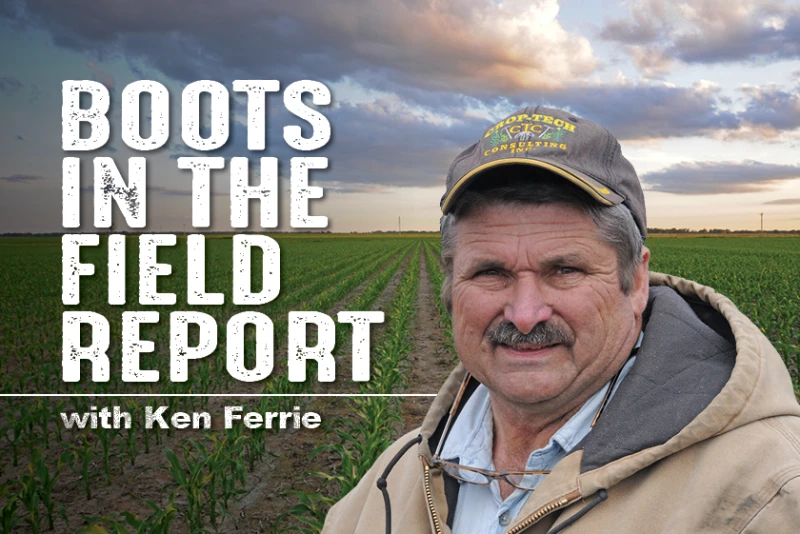
Farmers are working extremely long hours this spring, trying to finish up planting season. It’s been a tough go, with many growers dodging weather extremes – from dust storms to rain downpours – in the process.
“I’m not sure we’ve ever had to deal with as many roads closed to dust storms like we did on Tuesday in central Illinois,” says Ken Ferrie, Farm Journal Field Agronomist and owner of Crop-Tech Consulting, near Heyworth.
In other parts of the state, a lot of fields have been pounded by rain and will need to be hoed, especially timber soils.
“If you don’t have a hoe, use your planter,” Ferrie advises. “Set it the same way that we do when we use our planters to row fresh. Use the most shallow depth setting you can to get pressure off your closing wheels. Use your row cleaners with downforce to break that crust.”
Replant Decisions Are Underway
“We’re going to need to make some replant decisions very quickly in corn,” Ferrie says.
Proactively be looking for poor stands. If you or a neighbor has a drone, use it to scout fields to potentially spend up the scouting process.
“With corn, take the entire stand out and then replace it,” he advises. “Do not attempt to thicken up old corn stands,” he says.
“If you can’t bring yourself to tear it out, your stand is good enough,” he adds. “Don’t let the coffee shop tell you how to handle your replant decisions. This is not majority rules. Each field needs to be called on its own.”
Ferrie offers a replant calculator to help farmers make replant decisions. You can access it at www.croptechinc.com, under “tools.”
Soybean Weed Pressure Is High
Ferrie says farmers have some tough calls to make on soybean crops due to PPO herbicide damage and the crusting that has formed.
Much of the PPO issue that farmers are dealing with is in their non-GMO soybeans, as well as in wide rows.
He offers a soybean replant calculator on his website (see above) to help farmers identify when replanting is needed.
“Use common sense on when to thicken up stands,” he says. “For weed control, consider how weedy is the field to begin with?”
The weed pressure is intense this season, due to wide-scale failures of pre-plant herbicide programs – caused by weather extremes, which also prevented many farmers from even getting their herbicide applied.
Ferrie is seeing a lot of waterhemp breaks in fields.
“Now when you see an application skip, you realize that the herbicides are working but the amount of pressure breaking through is going to be a challenge. Post spraying is going to have to be pushed up on these weeds before they get away from us especially in those non-GMO fields.”
More Insects Are On The Move
Ferrie encourages pest teams to keep a close eye on their fields for insect feeding, especially the non-GMO fields.
In west-central parts of Illinois, near Jacksonville, farmers are already spraying for first generation corn borer in non-GMO corn crops.
These corn borer are already first instar, and they’re putting shot holes in the whorl. While it seems too early by the calendar for such feeding to be underway, by heat units, the pests are right on schedule.
“We’re already seeing cucumber beetles, June bugs and, soon, flea beetles. This also means the rootworm hatch will be moved up as well, which could be a challenge for the late-planted Double Pro corn,” Ferrie says.
Sins Of Spring Will Show Up This Fall
Many fields were worked wet this spring, as farmers were under pressure to get crops planted.
“Many fields were worked wet with the field cultivator and blew out a lot of clods,” Ferrie says. “These compaction layers will cost us more than a typical density layer, and they will have to be dealt with this fall.”
In addition, Ferrie says soybean fields that farmers worked wet this year should not be put into no-till next spring.
“We need to fix those compaction layers; they need to come out,” Ferrie says. “Keep this in mind when you’re thinking about signing up for Climate Smart Initiatives with no-till as part of the practice.”
Make sure to give this week’s Boots In The Field podcast a listen, as Ferrie goes into more detail on each of these topics. You’ll want to take a few minutes and give the podcast a listen here.



