

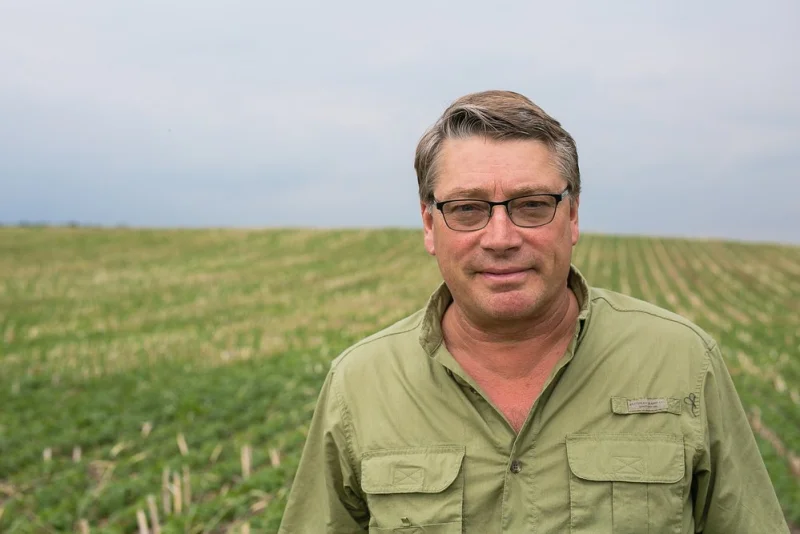
Every acre Les Seiler and his family farm in northwest Ohio has a cover crop planted on it, with the goal of keeping a living root in the ground year-round
“We try to mimic Mother Nature with what we do,” says Seiler. “Through no-till and cover crops we’re building our soil health, which is the No. 1 thing in our world.”
That’s not always been the case, admits Seiler, who farms with his brother, Jerry, and two of their sons near Fayette, Ohio.
Seiler recalls when he bought the land around his home in 2010, he initially decided to strip-till the ground that fall. It was a decision he soon regretted.
“All winter long, I watched that rich, black dirt blowing into the ditch bank right in front of my house, all because I had these nice, pretty strip-till mounds,” he says. “That was the last strip-tilling we did where we built mounds.”
The following spring, the Seilers switched their machine over to low-disturbance coulters, so they could still inject fertilizer, and they went heavier into cover crops. While they’ve moved on from that piece of equipment, their focus on using cover crops and no-till only intensified.
“We don’t use that fertilizer deep placement machine anymore because we can grow a lot of our own nutrients with cover crops,” he says.
Seiler shares two benefits he’s achieved with cover crops and no-till:
1. Biomass stays on the farm. Seiler says when the cover crops are terminated, he wants all the biomass to break down over time and be accessible to their corn, soybean and wheat crops.
“I do not want my biomass to leave the farm. I don’t want it to blow in the ditches,” he says. “I want it all to stay right where it’s at, and let the biological activity – which starts with the earthworms – break this biomass down and put it into a plant-usable form.”
Wind erosion removes the most fertile part of the soil, therefore, lowering soil productivity, Iowa State Extension reports. In addition, wind erosion can reduce seedling survival and growth, increase soil crusting, increase the susceptibility of plants to disease pathogens, and even create hazardous conditions on roads and highways. See Dust Storms Shouldn’t Happen in the Corn Belt
2. Nutrient and equipment investments can be reduced. Seiler says he still uses commercial fertilizer but has been able to reduce the amounts needed to reach his yield goals. He estimates he has reduced his nitrogen use by 20% to 30%.
“I stay flexible on my nitrogen program and will adjust some based on the season,” he says. “I expect to raise 200- to 220-bushel corn this year, and I’m putting on less than 190 pounds of N.”
Seiler adds that he will use a variety of technology and products, depending on the season, to boost corn performance.
“We have technology and tools today that my dad never dreamed of having. We can use in-furrow applications of products and micronutrients, things that can help a corn crop get off to a healthier start and mitigate stress in the process,” he says.
Change Requires A Different Mindset
Seiler says transitioning to cover crops and no-till was a process, and success didn’t happen overnight.
“Have we ever had a failure with this? I would say, no, but we’ve had plenty of learning experiences,” he laughs. “I’m a believer in soil health. That’s my goal. That’s how I’m going to farm, and I know these things can be made to work.”
For farmers interested in using cover crops and other conservation farming practices, Seiler recommends:
1. Start on a small scale. Seiler recommends committing as few as 10 acres and up to 50 acres to cover crops and no-till, starting out.
“You have to build your confidence over time,” he says. “In the process you figure out what your limiting factors are and what works, and you apply those learnings to the next year.”
2. Find a mentor. Seiler suggests connecting with like-minded farmers at meetings, joining conservation networks like Farmer Advocates for Conservation, and seeking out supportive retailers who understand regenerative farming.
“Find somebody that’s having success with this and talk with them. There are farmers who are doing this successfully that you can learn from,” he says.
Seiler cites two individuals who have been important mentors to him – David Brandt, an Ohio farmer who was a pioneer in the use of no-till and cover crops to improve soil health; and Jim Hoorman, who is an independent soil health specialist and former Ohio State University Extension educator.
“Once you have some confidence to do these practices, you can take them to the next level, but you have to have some confidence in yourself,” Seiler says. “You can’t worry about what the guy at the coffee shop is saying.”
3. Invest in other people by sharing what you learn. In the process of growing corn and soybean crops that are sustainable, Seiler and his brother routinely share their knowledge with others.
The farm actively hosts field days in conjunction with area soil and water conservation districts, the Natural Resources Conservation Service and The Nature Conservancy. They also have an Ohio State University water quality monitoring site on the farm. Seiler has shared his soil health knowledge at conferences and through videos and webinars.
“I know we’re saving soil, spending less on inputs, and we’re more profitable,” Seiler says of the conservation practices his family uses today. “Those are things I can feel really good about.”
Your Next Read: 3 Questions Every Farmer Should Ask About Biological Products



