

The way Tim Webster tells it, his 2025 cropping season was nearly a disaster. Summer delivered the lowest July–August rainfall his area had seen in 50 years. That lack and abnormally high temperatures pushed corn and soybeans to their limits.
“We had just enough moisture to get to the finish line,” recalls Webster, a sixth-generation farmer based just west of Lindsay, Ontario, Canada. The end result: corn and soybean yields came in at about half of normal.
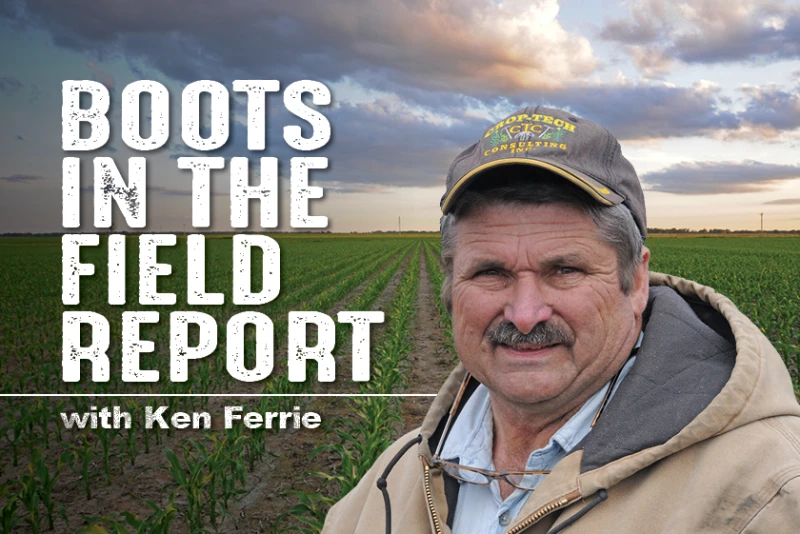
Webster and fellow farmer Steve Crothers, who farms on the north shore of Lake Ontario about 50 miles east of Toronto, recently sat down with Illinois-based Farm Journal Field Agronomist Ken Ferrie to talk about how they’re adjusting cropping plans for 2026 after last year’s drought.
Drought Reshapes Farmer Expectations
For Webster, last season was a stark reminder of how quickly yield potential can evaporate. Ultimately, Webster’s bottom line took a hit.
“We’re hoping that doesn’t repeat again,” he told Ferrie.
Crothers’ experience, though slightly better, was still defined by drought. Growing corn, soybeans, wheat and edible beans along Lake Ontario, he says it was the driest of his 40-plus years in farming.
“We had a couple half-inch rains, so we kind of ended up with three-quarters of our long-term average yield. So, we fared a little bit better,” Crothers says.
Still, the season left him and Webster concerned about their cropping plans and finances for this year.
Crop Insurance As A Lifeline
Ferrie drew a comparison between Canadian and American safety nets as he listened to Crothers and Webster describe their experiences. In the U.S., Ferrie notes farmers often lean on multiple levels of crop insurance to blunt losses in a bad production year. He asked whether similar options exist for Canadian farmers.
Webster replied that growers there do have a provincial crop insurance program, but participation and coverage levels vary.
“I think we all felt after last year, maybe we should have been insured a little higher. But we were very happy to have what we had to help pay the bills, that’s for sure,” Webster notes.
Crothers says specialty crops, including edible white beans and adzuki beans, come under similar insurance frameworks as corn and soybeans, though they have higher premiums because of their higher value.
Most of the white beans grown in his part of Ontario head to the United Kingdom, while the adzuki beans (also called mung beans) are shipped to Japan, Crothers notes. Those export markets add another layer of risk to already weather-sensitive crops, making insurance an important backstop when weather or markets turn against them.
Fertilizer Sticker Shock Hits Canadian Growers
If drought defined 2025, fertilizer prices loom large over this season for Canadian farmers, much like they do for U.S. farmers.
“For 2026 our biggest thing is hope — hope for typical average rainfalls after last year’s drought,” Crothers says. “And then, of course, the economic challenges with the fertilizer situation are obviously troubling to everybody.”
He tells Ferrie most fertilizer in his part of Ontario is not prepaid “The fellows using 28% are usually prepaid, because it’s been hard to get the last few years. But generally, not near as much fertilizer is prepaid as what, in a perfect world, would have been.” Crothers reports.
That leaves many Canadian farmers more exposed to potential sticker shock as they head into spring planting.
Webster says he pre-bought some of his nitrogen (N) in February and is now leaning hard into a strategy of splitting applications and dialing back on more expensive, slow-release N options where he can.
This year, for his wheat topdress program, fertility costs didn’t pencil out, forcing a change in his plans.
“It’s $32 more [per acre] to go with the time-release product versus straight urea,” Webster notes. “So, I think on our wheat this year we’re going to do a lot of split applications.”
With diesel, fertilizer and other costs trending higher, he says, “anything you can do to save small increments adds up … for the whole operation.”
Cropping Plans: Adjust Or Stay The Course?
Both farmers describe their region as an area where crop rotations remain fairly consistent: corn, soybeans and wheat typically share the mix. Asked whether high input prices and drought fears would drive large acreage shifts this season, Webster says his own operation plans to stay the course with its rotation, helped by a marketing strategy that spreads grain sales out over time to manage risk and meet mortgage payments.
Still, he’s aware some of his neighbors are recalibrating their cropping plans.
“I know some guys are going to go less corn, more beans — just less dollars to put it in,” Webster notes. “Maybe the profits aren’t as high, but there’s less risk involved.”
Ferrie notes that, similar to Ontario, many U.S. growers also appear to be largely holding to their established crop plans, as their major fertilizer and seed commitments were already made before input costs soared.
In a region still feeling the effects of the driest season in decades, both Webster and Crothers are essentially betting on a return to something closer to normal this season — average rains, manageable input costs and no repeat of last year’s extremes.
“If we get good yields, then we can deal with those [costs],” Crothers says. “But another weather year like last year would definitely be a struggle for a lot of people.”
Crothers and Webster spoke with Ferrie during a meeting hosted by the Durham Soil and Crop Association, a grassroots group that works under Ontario’s agricultural umbrella to bring new ideas, funding opportunities and conservation programs to farmers in the region.
You can catch the entire conversation between Ferrie, Crothers and Webster on this week’s Boots In The Field podcast, available below.



