

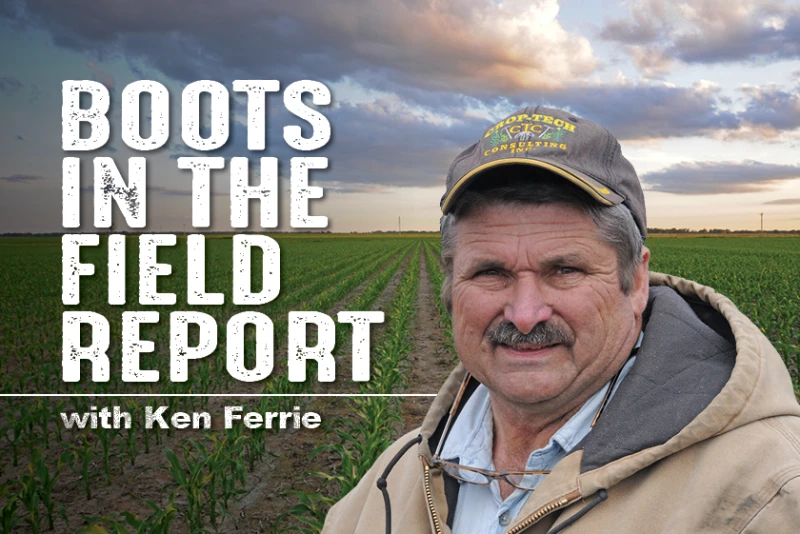
A lot of planting and agronomic decisions are being made across corn and soybean country this week. Ken Ferrie, Farm Journal Field Agronomist, offers his thoughts and recommendations on how to address some of the major agronomic challenges he sees.
Here are six questions he answers to help farmers struggling with weather delays, replanting concerns, using row fresheners and dealing with herbicide damage.
1. Do you recommend farmers focus on planting or replanting now, given that it’s May 10?
My advice is to worry about what is not planted at this point, before we worry about what to replant. As we roll forward, if your operation can only plant one crop at a time, my advice is to switch back to corn and finish your soybeans later.
If you’re running multiple planters and they are set up for corn, I would still throw my resources on the corn. The reason is our window to benefit from getting soybean plants to start flowering before the summer solstice has passed. There is more yield potential available with getting the corn planted now than getting these beans in the ground.
2. Given the timing, will I be better off going with shorter season corn hybrids?
Stick with your original plan. These full-season hybrids available today will adjust to the planting date. Pulling back on your full-season hybrids now would cost you yield and jam up your harvest this fall.
3. There’s been a lot of rainfall in some of our fields. What do you recommend for planting?
These planters are going to need to dance – carry the minimum downforce you can to maintain planting depth. Keep the row cleaners light, only move residue. Keep the dry soil at the surface and run the planter on that.
Some of these fields have what I refer to as bathtub rings, and they’re going to need to be addressed before you plant. Along with burning, we’re also using our row fresheners. Pulling out the row fresheners and going through those bathtub rings to get some air to the soil has been a good ticket for us. I realize not everyone has a row freshener, so this may be a good time to do some horse trading with somebody that does.
The strip-tilled fields are coming around the quickest here, especially those that are getting spring freshened. Running row fresheners on no-till fields as well helps to bump up the planting opportunity a couple of days. Here again, you guys running the fresheners make them dance as well. Stay shallow and light on downforce, focus on moving residue only.
4. Can my corn planter be used for row freshening?
Yes, it can. As a matter of fact, I would recommend trying it out so you get an idea of what a row freshener could do for you. You’re going to need to set your planter at its shallowest depth position. You’re going to take pressure off the closing wheels and back, and you’re going to run with as little down pressure as possible and let your row cleaners do the work of clearing the residue.
Your neighbor may think you’re nuts – that you’re “planting” a field twice – but it is a way to get started while Mother Nature dries out the rest of your fields.
Many fields are in that 80-20 situation where 20% of the field is under heavy residue. One pass with the row freshener will move that whole field to 100% pretty quickly.
Fields that need to be worked, now that’s another story. It’s going to take a bit to get dry enough to do this without putting in compaction, if you’re using horizontal tillage. The ribbon method still holds, so give it a try.
We don’t get a get-out-of-jail pass on compaction the second week in May. We will have to make the call and perhaps go when we’re in that 80-20 rule on tillage.
With vertical tillage it’s all about wheel tracks. When it’s dry enough to hold the tractor weight, only go deep enough in vertical tillage to take out the wheel tracks.
5. I still have cover crops to deal with. What do you recommend doing now?
We’ve heard a lot of concerns about waist-high cover crops, with growers wondering if they should take the cover crops out before planting. This big cover is going to cause some stiff carbon penalties when you’re going to corn. I’d advise that you front-load some nitrogen to help yourselves in these areas. The bigger the cereal rye, the more allelopathic issues we have to deal with as well.
Now, both issues would be good reasons to kill covers earlier. But at this point, you must ride it out. The reason is this live cover will be needed to pull the moisture out of these fields that are too wet.
When the ground is completely covered and shaded over, evaporation will not happen. You must then rely on transpiration, and transpiration only happens through live plants. Three good days of transpiration can dry out a field of live cover, while it could take two weeks with dead cover.
You will have to deal with the carbon penalty and the allelopathic issues no matter what. Don’t deal with a poor stand on top of that. Of course, the other option is going to soybeans.
6. My soybeans look like they have some herbicide damage. Should I be concerned?
We’re dealing with a lot of PPO damage on soybeans here in Illinois. Besides the standard flash on the cotyledons, we’re seeing damage to the arch which indicates that we got some splash of the PPOs as these beans were coming through the ground.
Now, many of these soybean fields are non-GMO fields, hence the use of the PPO preemergence. These populations are getting knocked around a little, but not enough to concern me on yield.
However, it is an issue for weed control in these non-GMO fields. If you have wide-row fields, any late-season weeds in these lower population fields will likely need to be addressed. I’d recommend finding a row-crop cultivator or bean walkers and/or bean walkers.
In the future, you may want to switch your seed treatment and/or herbicides as well as bump up your population in anticipation of stand loss.
Check out these additional articles on planting and Ferrie’s latest Boots In The Field podcast below:
The Drive for Planting Perfection
No Hands: Young Illinois Farmer is Now Taking Planting Tech to New Heights
How to Calculate Growing Degree Days (Simple Formula)
Smart Firmer: What Is It, What Can I Do With The Data?
Ken Ferrie: 7 Tips To Overcome Moisture Concerns At Corn Planting



