
News
Today’s agriculture headlines and expert perspectives serving farmers, ranchers, crop consultants, livestock nutritionists and the entire U.S. ag community.

The EPA says the changes will still deliver nearly 90% of the pollution reductions while saving an estimated $12 billion, though environmental groups warn the rollback will increase health harms.

Two Midwest farmers report they are ready to treat corn acres, but uneven stands and tight margins cause hesitation for soybean applications.

Sponsored
Weather events can rob soybean yields at critical growth stages. Know when your crop is most at risk.

From unseen air-quality hazards to 1,000‑pound pull forces, grain bins stack the odds against untrained rescuers, says firefighter Dave Newcomb. He tells farmers how they can respond better and offers four steps to take.

Under a 10-year settlement, farmers gain the same capabilities as dealers to reset fault codes, pair electronic components and bypass emissions-related shutdowns.
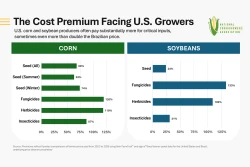
Analysis of 2023–2025 prices found U.S. growers paid more for nearly every seed and crop protection category examined.

President Jed Bower says the association is setting a course toward markets that could collectively unlock demand for billions of additional bushels of corn annually, “keeping farmers farming” for the next 250 years.

An unusual combination of severe hail, 88 mph winds and excessive rainfall has devastated some corn acres, while saturated fields, delayed herbicide applications and rising weed pressure threaten remaining yield potential.

Recent sales show late-model combines and tractors attracting premium prices with limited options in the traditional five- to 12-year-old range.

Cutting, crafting, and welding, Frank Smith turns a shop rebuild into a tractor corral.

While, not yet confirmed by the U.S. Trade Representative’s office, Arlan Suderman, chief commodities economist, StoneX says the tariffs could be dropped by October 1.

Six technologies advance toward commercialization, with the first product expected in late 2026, despite criticism from environmental advocacy groups.

As crops accelerate through key growth stages, Mark Herz, agronomy technical specialist at CHS, shares three priorities for midseason crop scouting.

Sponsored
Warm, humid weather can increase purple seed stain risk in soybeans during R5-R6. Here’s what to do.

After more than 400 years, Shirley Plantation remains both a working farm and a living record of American ag. Not only is it the oldest family-owned business in America, but it still unlocks pieces of America’s past.

High-oleic soybeans are helping this Wisconsin dairy turn homegrown feed into lower costs, higher butterfat and greater control over its operation.

Located along Virginia’s James River, Berkeley Plantation is the site of America’s first Thanksgiving in 1619, the birthplace of President William Henry Harrison and a thriving 400-year-old working farm.

Farm Journal’s June Ag Economists’ Monthly Monitor shows a weaker ag economy versus a year ago, but more than 80% expect consistent or better conditions over the next 12 months despite ongoing margin pressure.

New equipment sales are down over 12% as 6 out of 10 farmers report worsening finances. Experts Curt Blades and Casey Seymour break down the market in a high-cost ag economy.

Luke Lindberg points to stronger export sales, reduced trade barriers and expanded opportunities in markets including Ghana, Australia and Vietnam.

For 100 years, Ed Koger’s family has bought Angus bulls from Dalebanks Angus, proving in the cattle business, the most valuable trait you can breed for is integrity.

Virginia’s Mainland Farm is considered America’s oldest continuously farmed land, cultivated since the early 1600s. Today it still produces crops while preserving 400+ years of agricultural and Revolutionary War history.

The U.S. lets the 16-year USMCA extension deadline pass, opting for rolling annual talks. Experts break down what this means for “predictability” and the leverage needed for disputes.

How one Montana farmer connected conservation to efficiency and market opportunity for his farm

The goal is to increase domestic fertilizer supply and strengthen the supply chain.

Sponsored
Silverleaf whiteflies threaten cotton yield and fiber quality late in the season. Know the signs.

Higher beef prices and grocery inflation are pushing the cost of a backyard barbecue higher in 2026.

Marshall and Loretta Ensor transformed an 1890s farmhouse into a hub for amateur radio, teaching 10,000 operators by air and helping shape the early history of wireless communication.

Persistent rain is shifting nitrogen from a fine-tuning tactic to a rescue tool. Ken Ferrie shares how to manage N-deficient corn, the “last best” window for ROI and how to protect grain fill.

In late June, the agency revised its technical guidelines for biofuel feedstocks related to the 45z tax credit.