

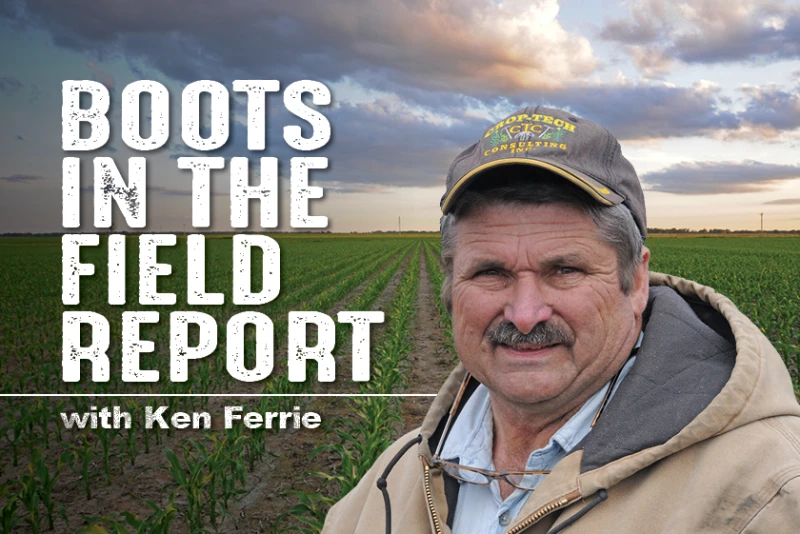
With harvest now in the rearview mirror in many areas, farmers are focusing their attention on fall tillage. The soil type you’re working in and where you farm are making a big difference on how fall tillage is going, according to Ken Ferrie, Farm Journal Field Agronomist.
Some fields in Illinois and surrounding states that had excessive rainfall last spring have ruts and compaction to address but are currently in the midst of D2 and D3 drought levels. With that challenge in mind, Here’s a look at some tillage options by system:
Strip-Till: In lighter soils – particularly light silt loams – Ferrie says farmers are creating good strip-till berms, with few to no chunks or clods that will have to be addressed next spring.
“These will mellow out and create a pretty decent seedbed next spring. Even though the soil is hard and dried out, the lighter soils are stripping nice,” he reports.
That’s not the case where farmers are working heavier ground with clay to clay-loam soils. Strip tilling in these soils is creating a rougher environment that Ferrie is afraid will lead to some tough seedbeds next spring.
“If you’re running a strip freshener next spring, much of this problem can be corrected, but only if you’re running that freshener before these large clods become dried clods in the spring,” he says. “Clods that get smashed into the furrow by the planter next spring will create some germination issues.”
If you use a strip freshener, one avenue Ferrie says you might consider is to bypass the fall strips and just freshen them in the spring to achieve a good seedbed. But if conditions continue to be dry going into next spring, he would advise farmers to conserve available moisture and just no-till the field.
Conventional-till: To eliminate ruts in conventional-till, use a chisel plow or disk ripper on cornstalks, then follow with a leveling pass next spring. Run a chisel plow at a slight angle across the wheel tracks to break up soil compaction.
In bean stubble with 4" ruts, use a soil finisher and level in the spring. If ruts are 6" to 8", use a chisel plow to fill them in first. If possible, spot chisel to fix only the areas in the field with ruts. Follow with a soil finisher pass next spring. Use aerial imagery from the growing season to help determine whether you can patch the field or if it all needs to be worked.
Vertical-till: In a corn-to-soybean rotation with ruts or severe pinch rows, use a chisel plow in the cornstalks followed by a vertical-till leveling pass next spring. When using a chisel plow, make sure you achieve full width shatter from shank to shank for optimum results, Ferrie says.
In a soybean-to-corn rotation, use an in-line ripper in bean stubble when dealing with pinch rows and 4" ruts. Run the in-line ripper at an angle to make sure you cross the ruts or pinch rows. If you run with the rows, it might not bust wheel tracks apart; it will only pick them up and set them back down. In these scenarios, it will likely take two passes with a vertical-till leveling tool next spring to eliminate the tracks.
In 6" to 8" ruts, don’t use an in-line ripper. Instead, Ferrie suggests using a chisel plow. If ruts are spotty, chisel them in first and then in-line rip the entire field, leaving a large portion of the field covered in residue. If deep ruts appear across the entire field, run the chisel plow across it all.
Be sure to respect land contour to eliminate erosion.
Deep ruts usually aren’t an issue in strip-till and no-till fields because the soil is more firm. However, take action to fix tracks and 2" to 4" ruts, as the benefits far outweigh the risks.
No-till: Ruts usually aren’t too big of an issue in no-till fields because the soil is firm. However, don’t let a 4" rut or pinch rows fool you. Both can be hard on ear counts the following year.
If you’re dealing with wheel tracks in a no-till soybean scenario, there’s a good chance freezing and thawing paired with a vertical-harrow tool will do the trick. If fixed, you can return to no-till the following year.
With 4" to 6" ruts in cornstalks followed by soybeans, plan to shallow chisel the field to achieve full width shatter and then level with a vertical harrow. Once fixed, the field can return to no-till the following year.
In soybean stubble with ruts in small portions of the field, patch it with tillage and continue to no-till the rest of the field. If pinch rows or ruts are present across the entire field, use vertical tillage to address the problem and then return to no-till in future years.
“Ultimately, in order to avoid long-term yield effects, fields might have to come out of no-till or strip-till to fix ruts and compaction issues,” Ferrie says. “Ruts often show up in aerial imagery for two to three years. As soon as the problems are fixed, the field can return to no-till or strip-till.”
Anhydrous Ammonia Considerations In Dry Soils
Without some rainfall in areas suffering from drought, Ferrie is concerned anhydrous ammonia (NH3) applications will be challenging to seal. In some cases, when growers are smelling ammonia a day after application, that means the product is making its way to the soil surface and being lost.
Ferrie says you should be able to stand out in the field as NH3 is applied and not see it or smell it. That was not the case this past week in some central Illinois fields.
“I saw one field that had cracks big enough that you could put your hand down in them. The anhydrous bar was not only smoking around the knives, gas was coming out through the cracks in the soil between the knives,” Ferrie reports.
Anhydrous ammonia will move in soils until it finds enough soil moisture to convert from ammonia to ammonium. In dry soils, an inhibitor will be ineffective because it is designed to stop nitrification and not volatility.
“That’s why growers wonder why they can smell ammonia leaking out of a dry soil when they use N-Serve. It doesn’t work like that. You’re not protected against volatility,” Ferrie explains.
Instead, N-Serve acts to slow down the bacteria that converts ammonium to nitrate, keeping nitrogen in the ammonium form longer.
European Corn Borer Populations Rebuild
Ferrie says he had a number of farmers call in this fall regarding certain hybrids that were dropping ears. Most of the fields contained non-GMO hybrids, and in many cases the problem was caused by European corn borer and the hybrid was not at fault.
Ferrie advises farmers to inspect ears from the fields in question, if still available, for telltale signs of the pest. “Look at that butt of the ear in the shank,” he says. “Corn borer will leave a tunnel in the shank, or through the center of the cob, coming out the butt of the ear into the shank.”
Ferrie says he is seeing populations of the pest starting to rebuild in areas where non-GMO corn has been grown multiple years.
“Corn borers have been gone so long, most growers have forgotten about them, or they’re too young to have farmed when corn borer was a threat,” he explains. “Inspecting some ears now will give you insights on what you’re dealing with and a leg up on what you need to plan for next season.”
Learn more of Ken Ferrie’s recommendations on how to address tillage, NH3 and pest control in his latest episode of Boots In The Field:
Your next read: Unpacking the Disappointment: 5 Reasons Some Iowa Growers Had Ho-Hum Corn Yields



