
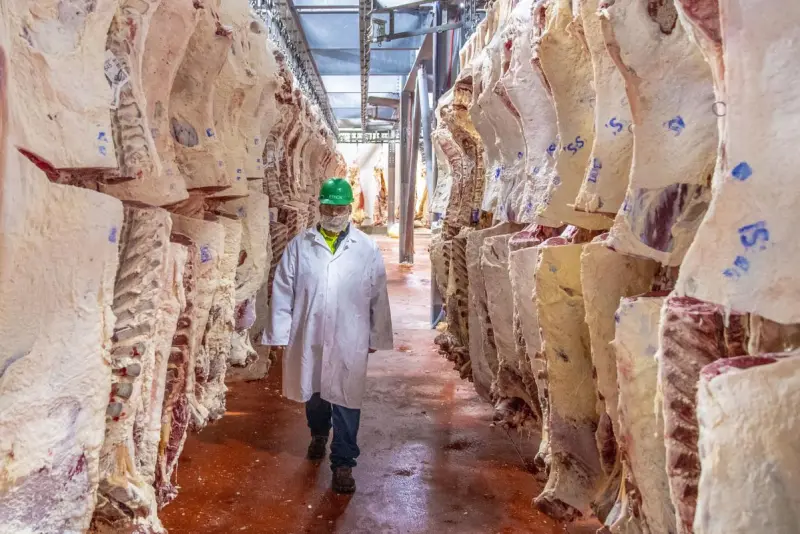
President Donald Trump says he wants the Department of Justice to immediately begin an investigation into meatpackers for driving up the price of beef. The directive marks a turnabout from previous statements about U.S. ranchers making good profits and their impact on the price of beef at the grocery store, which the administration has said remains too high.
In a statement on his Truth Social site, the president calls for “An investigation into the meat packing companies who are driving up the price of beef through illicit collusion, price fixing and price manipulation.”
He says American ranchers are being blamed for what is being done by majority-foreign-owned meatpackers.
“[The packers] artificially inflate prices and jeopardize the security of our nation’s food supply,” writes Trump. “Action must be taken immediately to protect consumers, combat illegal monopolies and ensure these corporations are not criminally profiting at the expense of the American people.”
Attorney General Pam Bondi responding to the post saying the DOJ investigation is already underway.
”My Antitrust Division, led by [Abigail Slater, Assistant Attorney General at the Department of Justice Antitrust Division], has taken the lead in partnership with our friend [Ag Secretary Brooke Rollins] at USDA,” she says.
Our investigation is underway! My Antitrust Division led by @AAGSlater has taken the lead in partnership with our friend @SecRollins at @USDA. https://t.co/KP0zlO9RQg
— Attorney General Pamela Bondi (@AGPamBondi) November 7, 2025
Rollins, also responded to Trump’s social post, thanking him for standing up for America’s farmers, ranchers and consumers.
“For far too long, hardworking ranching families have been squeezed by massive foreign-owned meatpacking corporations manipulating prices and driving family operations out of business,” Rollins wrote. “These global monopolies profit while everyday Americans pay more at the grocery store and rural communities struggle to survive.”
Rollins, in her post, calls for transparency and accountability that lead to a fair market for beef producers.
THANK YOU, @POTUS for standing up for America’s farmers, ranchers, and consumers! 🇺🇸
— Secretary Brooke Rollins (@SecRollins) November 7, 2025
For far too long, hardworking ranching families have been squeezed by massive foreign-owned meatpacking corporations manipulating prices and driving family operations out of business. These… https://t.co/qiftHNtA1q
“Thank you, President Trump, for fighting for the heartland, for our farmers and ranchers, and for standing up to the corrupt forces that threaten our food security and American independence,” Rollins said.
According to Reuters, “Ranchers have long complained about consolidation in the packing industry, where Tyson, Cargill, JBS and National Beef Packing Co. together control around 80% of the market.”
Industry Reaction
The Meat Institute released a statement following President Trump’s comments:
“Despite high consumer prices for beef, beef packers have been losing money because the price of cattle is at record highs,” said Meat Institute President and CEO Julie Anna Potts. “For more than a year, beef packers have been operating at a loss due to a tight cattle supply and strong demand.
“The beef industry is heavily regulated, and market transactions are transparent. The government’s own data from USDA confirms that the beef packing sector is experiencing catastrophic losses and experts predict this will continue into 2026.
“U.S. beef processors welcome a fact-based discussion about beef affordability and how best to meet the needs of American consumers, who are the industry’s most important stakeholders.
“Beef packers rely on cattle producers and cattle producers rely on beef packers. The entire beef value chain is strongest when supply is balanced by demand. Beef packers remain committed to ensuring safe, delicious, and nutrient dense beef remains affordable to American families who rely on its nourishment. We welcome the President and his team to visit our members’ beef facilities, both large and small, to witness firsthand the pride, skill, and dedication they bring to their work every single day.”
For more on beef and cattle market conditions go here.
United States Cattlemen’s Association shared their thoughts on social media, “Yes, let’s keep American ranchers out of the crosshairs. But, USCA will continue to state that beef prices in the grocery store are not too high. Prices are a direct reflection of consumer demand — consumers want US beef.
“Ranchers continue to show resilience and dedication, battling drought, inflation, and unpredictable pressures daily, yet still deliver top-quality, safe beef for families across the country.”
National Farmer’s Union also shared these thoughts: “We agree— American ranchers aren’t to blame for high beef prices.”
R-CALF USA CEO Bill Bullard issued the following statement in response to the announcement.
“We greatly appreciate President Trump’s announcement that he’s directed the Department of Justice to investigate the beef supply chain to determine if there are any violations of our fair competition laws or antitrust laws.
“There has long been a disconnect between cattle prices and beef prices, and we believe this is evidence of market failure. We welcome this investigation to ensure that cattle producers receive competitive prices for their cattle, and that consumers pay prices set by a competitive market rather than a monopolistic one.”
Previous Retail Price Comments
Trump previously posted: “The Cattle ranchers, who I love, don’t understand that the only reason they are doing so well, for the first time in decades, is because I put Tariffs on cattle coming into the United States, including a 50% tariff on Brazil.”
Donald J. Trump Truth Social 10.22.25 12:42 PM EST
— Commentary Donald J. Trump Posts From Truth Social (@TrumpDailyPosts) October 22, 2025
The Cattle Ranchers, who I love, don’t understand that the only reason they are doing so well, for the first time in decades, is because I put Tariffs on cattle coming into the United States, including a 50% Tariff on Brazil. If…
Following the post, the National Cattlemen’s Beef Association (NCBA) made a post on Facebook in response and also released a statement on the president’s steps to undercut U.S. cattle producers: “In a misguided effort to lower the price of beef in grocery stores, President Trump said he plans to increase the volume of beef being imported from Argentina. Efforts to manipulate markets only risk damaging the livelihoods of American cattlemen and women, while doing little to impact the price consumers are paying at the grocery store.”
“The National Cattlemen’s Beef Association and its members cannot stand behind the President while he undercuts the future of family farmers and ranchers by importing Argentinian beef in an attempt to influence prices,” said NCBA CEO Colin Woodall. “It is imperative that President Trump and Secretary of Agriculture Brooke Rollins let the cattle markets work.
“The U.S. already faces a deep trade imbalance with Argentina, one that is made worse by the President’s plan,” he continued. “During the past five years, Argentina has shipped beef valued at more than $800 million to the U.S., while purchasing only $7 million of U.S. beef. Furthermore, Argentina is a nation with a long history of foot-and-mouth disease (FMD), and USDA has not completed the necessary steps to ensure Argentina can guarantee the safety of the products being shipped here, further endangering America’s cattle herd.
“If President Trump is truly an ally of America’s cattle producers, we call on him to abandon this effort to manipulate markets and focus instead on the promised New World screwworm facilities in Texas; making additional investments that protect the domestic cattle herd from foreign animal diseases such as FMD; and addressing regulatory burdens, such as delisting of the gray wolf and addressing the scourge of black vultures,” Woodall said, concluding the statement.
Your Next Read: Unpacking the Beef: Report Clarifies Cattle Market Realities, Packer Challenges & Trade Tensions



