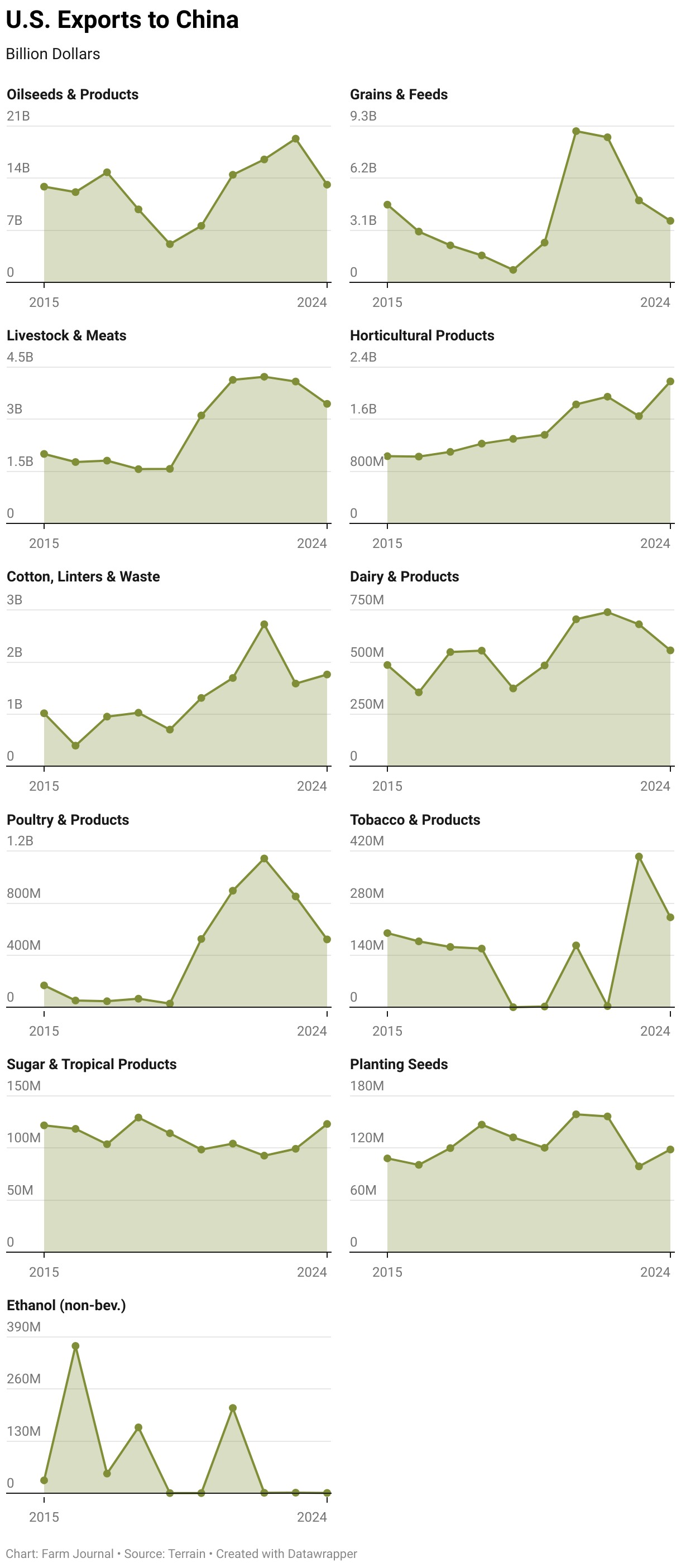
Just days after President Donald Trump announced responsive tariffs impacting 186 countries, China is hitting back. On top of the tariffs China already has in place, it’s matching the additional 34% tariff the U.S. announced on April 2.
The White House said on Wednesday it’s pursuing reciprocity to rebuild the economy and restore national and economic security. In a White House fact sheet, Trump declared foreign trade and economic practices have created a national emergency. His order this week “imposes responsive tariffs to strengthen the international economic position of the United States and protect American workers.”
The tariffs President Trump unveiled on Wednesday are a move poised to cause a major reset of relations and worsen trade tensions between the world’s two largest economies.
As China slaps back, U.S. pork exports will now face a 81% tariff, while the tariff on beef is now 56%.
“These rates represent the sum total of China’s 12% most-favored-nation tariff, plus retaliatory duties previously imposed by China, plus the new duties set to take effect April 10,” says Dan Halstrom, U.S. Meat Export Federation (USMEF) CEO.
What’s at Risk for Ag?
It’s no secret China isn’t the giant export destination it was before the previous trade war. For years, China remained the top destination for U.S. ag exports, but now Mexico holds the top spot and Canada is second. In 2023, U.S. ag exports to China decreased, and China’s share of total U.S. exports fell to a four-year low.
What caused the shift? Economists say there are a number of factors, including fallout from the first trade war, increased competition from other countries, changes in Chinese import policies and a slowdown in China’s demand for certain U.S. ag products. It’s important to note, Brazil’s market share in China has been growing.
U.S. Pork and Beef Now Face 81% and 56% Tariffs
The tariff rates now placed on U.S. meat are hefty, and USMEF says the impact could be significant, especially for pork.
“U.S. beef already faces major obstacles in China related to plant eligibility, so an increase in retaliatory duties puts exports in even greater jeopardy. Unfortunately, taking China out of the export mix also impacts the price U.S. beef cuts command in markets like Korea, Japan and Taiwan,” Halstrom says. “China’s duties on U.S. pork were already daunting and will now be massive, which severely impacts exports of pork variety meat. These exports equate to about $10 per U.S. hog, with China accounting for more than half of that total. USMEF remains hopeful that negotiations will be held soon to address these issues.”
While this does create new challenges and makes U.S. meat even less competitive for China, U.S. pork exports hit a record-high in 2024.
According to USMEF, China accounted for 15% of total U.S. pork export volume last year and 13% of export value. Variety meat was much higher. China took 54% of U.S. pork variety meat shipments, accounting for 59% of the value of these products.
As for beef, China accounted for 14% of total U.S. beef export volume last year and 15% of export value.
The Situation for Soybeans
When it comes to U.S. soybeans, China has historically been a major buyer, but sales have dropped in recent years, and China now turns to Brazil for more soybeans.

Based on analysis by Terrain, China’s economic struggles and years of stockpiling have reduced demand for U.S. soybeans. Imports in 2024/25 were down 3% to 4 billion bushels. According to Terrain, it will be hard to reverse course on this trend.
“A renewed trade deal would offer false hope. Brazil has been busy feeding China soybeans (supplying nearly three times as much as the U.S. in 2022/23),” analysis by Terrain stated. “China met only 60% of its prior commitment in the Phase One agreement in 2020/21, is now aligned with Brazil and has been for years, and has stagnant demand.”
Even though China’s appetite for U.S. ag products, specifically soybeans, has waned, the commodity markets are nervous about what retaliation could mean for demand. Soybean prices reflected that concern on Friday, with the May contract down nearly 40¢.
According to AgMarket.net’s Matt Bennett, exports are at risk. When Brazil’s harvest hits the market that’s what China will be buying. Even then, outstanding sales of soybeans could take a hit.
“We have some unshipped sales right now for soybeans. They haven’t been buying any corn. Bottom line: They’re buying most of their beans off of Brazil and will be from this point forward,” Bennett says. “That would be one of my concerns, though, is you’ve got a balance sheet right now of 380 million bushels for soybeans. What if we lose 15 or 20 million bushels because some of these sales turned into cancellations? There’s no doubt we could see some of that retaliation.”
Bennett says it’s also key to remember this isn’t a one-way street. The U.S. is a major destination for China’s exports, including consumer products.
“We have to remember we’re the biggest destination as far as where they’re shipping products,” Bennett says. “I mean, we are the world’s largest consumer. They’ve been doing good business with us, but just like we’ve seen with some of the other countries, there’s trade imbalances here that probably need to be addressed. The short-term pain, if you will, is hopefully going to be followed up by maybe some long-term benefit.”
AgResource Company’s Dan Basse says the tariffs are also fuel for Russia to strengthen its alliance against the U.S.
“I think [President Vladimir Putin] is going to keep marching with the war,” Basse told “AgriTalk” host Chip Flory. “He’s going to be difficult to deal with. The ruble is strengthening, giving them a little more fortitude. I imagine Russian farmers are not happy about [the reciprocal tariffs], and maybe they won’t plant as much grain going forward. But other than that, I think it will be status quo, and [Putin] is kind of teaming up, if you will, with China and that BRIC alliance to somehow show their strength against the United States.”
34% Tariff is in Addition to 20% Tariffs Already in Place
Even before China’s retaliation this week, American Farm Bureau Federation (AFBF) analysis from March showed Beijing had specifically targeted 15 products, including beef, cotton, grain sorghum, pork, corn and dairy along with fresh fruit.
According to AFBF, the top five products impacted by China’s original 20% retaliatory tariff, in terms of the value of 2024 exports, are:
- Soybeans ($12.8 billion)
- Cotton ($1.5 billion)
- Grain sorghum ($1.3 billion)
- Frozen boneless bovine meat ($1 billion)
- In-shell pistachios ($627 million)
“China has made up a quarter or more of U.S. global agricultural exports for 10 targeted products over the last five years: macadamia nuts (99%, $12 million), frozen swine carcasses (96%, $25 million), grain sorghum (88%, $1.3 billion), frozen swine offal (75%, $593 million), soybeans (53%, $12.8 billion), frozen unboned hams, shoulders and cuts thereof (45%, $7 million), in-shell hazelnuts (38%, $8 million), cotton, not carded or combed (29%, $1.5 billion), frozen boneless bovine meat (27%, $1 billion) and in-shell pistachios (25%, $627 million),” according to the AFBF report.
Economists say while it’s too early to measure the full impact of the tariffs on U.S. agriculture, they believe it will certainly decrease demand for U.S. products in China.
Comparing the Possible Impact of Trade War 2.0
The March Ag Economists’ Monthly Monitor found while 92% of economists think the U.S. is already in a trade war, 69% say they don’t think a trade war today would have the same impact it did 2018 through 2020.
“When you look at China, Brazil and soybeans, we don’t have as much of the market to lose as we did the first round,” one economist said.

However, many economists think a trade war, this round, will have a more severe impact on agriculture.
“The trade war in 2018/19 also had the African swine fever [ASF] in China in the mix,” one economist said in the monthly survey. “Because of ASF, they did not need the soybeans anyway. It will be hard to figure out what impacted the U.S. markets/prices more, but the market reaction should not be as great this time.”
“It would be a bigger impact,” said another economist in regard to another trade war with China. “The first round of trade wars in agriculture were largely used as a wedge for negotiation or renegotiation of agreements that provided improved access and growth opportunities for ag trade. This round seems to be championed based on reshaping the entire trading system, a system that U.S. agriculture largely benefited from over time.”

When economists were asked who ultimately wins in a trade war, none said the U.S. The majority of ag economists (73%) say it’s ultimately one of the United States’ biggest competitors: Brazil. Eighteen percent, however, think China will benefit from the latest trade war.