

Rain showers have slowed or stopped planters from advancing in fields across parts of the Midwest, including Illinois, Iowa and Minnesota. The situation continues a wetter-than-normal pattern that has been in place for the last several weeks, according to the U.S. Drought Monitor.
One farmer who was chased out of fields by rain this past weekend told Farm Journal, “This is the wettest drought I have ever seen.”
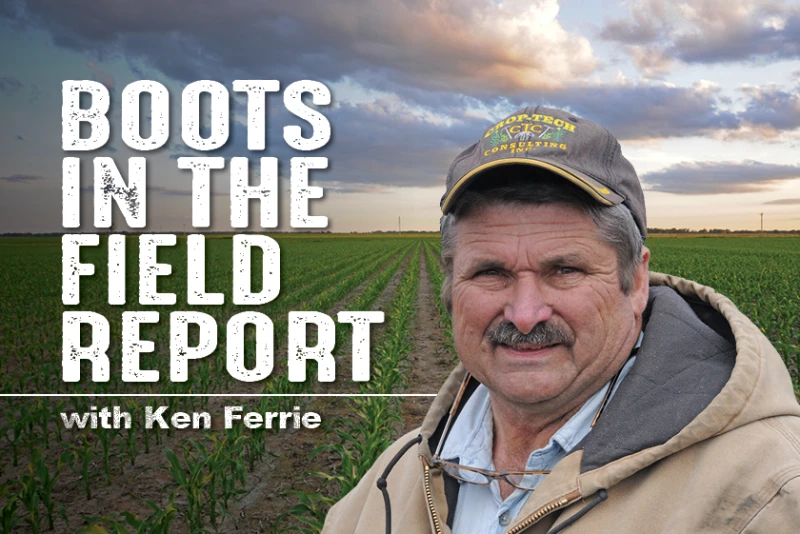
In central Illinois, Ken Ferrie says farmers there are also dealing with rain and rain delays but that there is a silver lining to be had.
“There is a lot of upside potential from the moisture – getting our soil-applied herbicides working for us, and helping some of those soybean stands that are struggling to emerge in timber soils,” says Ferrie, Farm Journal Field Agronomist.
“This keeps our national corn crop from being in the exact same stage of growth all at once, meaning this entire crop isn’t going to try and pollinate in the same week – which could happen to be 110 degrees at the time. We just won’t know until we get there.”
Sure, there are valid concerns farmers have about getting crops planted, but looking ahead to identify benefits on the back side of the production season can provide some encouragement.
“Breaking up this planting window helps us all the way to the harvest, when we start knocking these fields out with the combine. We don’t want our corn and soybeans being too dry at harvest, which causes its own set of issues,” he says.
With that said, Ferrie offers four suggestions to consider for the week ahead:
Keep your powder dry if the weather outlook and soil conditions are crummy. If you jump the gun and muddy corn into wet, cold soils this week that could cost you big. Ferrie says you could easily lose 30 bushels per acre in that scenario.
“In that event, you could have waited until May 20 to plant and ended up with the same corn yield at harvest and a lot less replant to deal with now,” he explains. “Of course, there would be some drying costs to consider in that picture as well.”
Assess corn stands for replant decisions. If your situation is the corn got planted but then rains moved in, this is the time to swing back to those fields and evaluate emergence. Those fields that show signs of trouble need to be tended to sooner than later.
“We’re still early in the planting window, and replant decisions can be made without giving up any yield at this point,” Ferrie says. “With corn, you’re not only looking for emergence numbers, you’re looking at uniformity of emergence as well.”
Expect any plant that’s more than one collar behind its neighbor to be a small or no-eared plant. Furthermore, Ferrie’s experience is if corn was mudded into the field, you’ll likely have about two-thirds of a normal stand – rather than little or no stand.
Another issue to keep in mind are any seed corn lots you planted that had low test scores. Even if you planted those lots in good conditions, they still might not perform well.
Ferrie recommends verifying that ear counts are high enough to hit the yield goals that you’re after. Use those insights to guide the use of inputs and/or whether you need to replant the crop.
“Remember, we don’t thicken corn stands up, especially this early. We take them out and we start over,” he says. “However, if you are planting at 36,000 (population) hoping for a 35,000 ear count but end up with 26,000 due to your planting conditions, it might not pay to replant in $4 corn,” he adds.
Factors to consider if you’re planting soybeans. Ferrie says to put your early soybean maturities into the ground this week.
“Because it’s May 5, plant your earlier maturity beans first as we’re now in the ‘normal’ planting window,” he advises, “Then, finish with your full-season soybeans.”
This direction is just the oppositive of what he recommends when Illinois farmers want to plant early soybeans. If it was still early planting season, Ferrie would be saying to plant full-season soybeans first (based on your maturity zone) and then finish with your shorter-season soybeans.
If you feel you have to plant soybeans in tough soil conditions and get a less than ideal stand, don’t give up on the crop — soybeans have a remarkable ability to compensate.
“Because soybeans set their yield later in their development, a tough start for beans doesn’t carry the yield penalty that it does for corn,” Ferrie points out.
An important side note: Make sure your planter is set to do a good job of singulating for soybeans. That will help you get a more uniform pod load, which is important to yield outcome.
Anticipate pests showing up in fields now or headed your way. Ferrie says black cutworm (BCW) is moving into Illinois and other states, and farmers need to be on the lookout for feeding. Any field that had a green cover the last part of March to early April will carry the biggest risk.
“All cover crop fields will need to be watched, including the fields where chickweed and henbit were used as covers,” he says.
Ferrie cautions farmers that if they worked a cover crop in at the end of April, that does not take away the threat of cutworms. The eggs have already been laid.
“Guys, cutworm is easy to kill, so let’s not drop the ball on this one. Scouting from the road is not recommended. When you notice a stand disappearing from the road, you’re usually behind the eight ball already. And scouting cover crop fields from the highway is impossible.”
Ferrie adds that there has been a noticeable presence of true armyworm moth in traps. “That means we’ll have to keep an eye on this insect as heat units continue to climb. Cover crop fields, fields next to the cover crops and our wheat crop will need to be watched,” he says.
Join us this summer at the Farm Journal Corn & Soybean College. The two-day event, scheduled for July 22-23, is now open to you for registration. Ferrie and team host the annual agronomic program at their Crop-Tech Consulting facility based just south of Bloomington, Ill.
This is an unsponsored event making more time for our agronomists to spend with attendees, getting their questions answered, and more time to spend in the field. We hope to see you there!
Catch Ken Ferrie’s latest agronomic insights and recommendations in this week’s Boots In the Field Podcast:
Your Next Read: Sap Tests Can Help Reduce Nutrient Use, Improve Crop Health and Boost Yields



