

Recent rainfall in parts of the Midwest has been a double-edged sword for farmers.
On the one hand, it’s been a welcomed event, restocking water tables in many areas and setting up corn and soybean ground for good freezing and thaw cycles this winter.
On the other hand, the rains have slowed or prevented many farmers from getting their fall tillage or strips completed.
Evaluate Soil Conditions
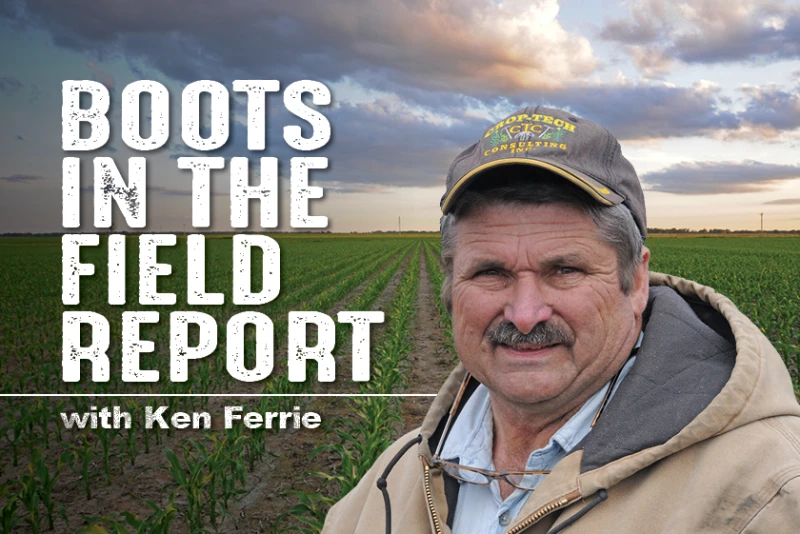
Farmers always need a plan B for fall seasons like this, notes Ken Ferrie, Farm Journal Field Agronomist.
“One plan is to be ready in case the window opens up in December for you to finish up,” he says.
However, Ferrie adds that a bad strip built now won’t make for a good seed bed next spring.
“My advice – if you have a row freshener – is make that your plan B. Make your strips next spring with the freshener a week or two ahead of planting,” he advises, adding: “I’m not a fan of running a strip till bar with a knife in the spring. And while it works better in the sandier soils than it would in the clays, it tends to create a rough and kind of tough seed bed to plant into.”
He adds that good seed beds have uniform moisture at seed depth at planting time.
“Running a knife in the spring, you’ll become very dependent on timely rainfall to settle that strip, reset that moisture, without the help of freezing and thawing. Take the knives off and let the row cleaners and the coulters do the work,” Ferrie advises.
Consider Your System
When it comes to fall tillage, the decision you make now really depends on what system you’re running. If you’re in a horizontal tillage system – where you’re going to be fall chiseling, followed by one or two horizontal passes next spring, like with the field cultivator or soil finisher disc – you’ve got time to evaluate options, Ferrie notes.
“Your fall pass will be more of a function of traction,” he says. “Can you pull it? In a horizontal system, you don’t need to have full-width shatter, because your finishing pass is what makes the seed bed.
“This primary pass can be done in the spring, but you’ll need to keep your finishing pass coupled to the primary pass if this happens – beyond the window of freezing and thawing – to help you melt down those clods,” Ferrie adds.
Plans For A Vertical System
Ferrie says if you already farm in a vertical system, you still need to get full-width shatter with your primary tillage. Your primary tillage is part of your seed bed-prep. He explains that full-width shatter is a function of shank spacing, shank depth, soil moisture, horsepower and traction.
“No matter when this tillage is done, we need the top 4" to 6" to be shattered,” he says. “This is harder to do with the disc rippers, where you’re trying to go deep. It’s going to be easier to do with the hybrid chisels running closer shank spacings.”
If you’re already farming in a vertical system, farming without layers, Ferrie’s suggestion would be to consider making your plan B for tillage no-till.
“This has been a good fall for no-tilling – no combine or grain carts to deal with. You have plenty of time to put your fall burndown on for weed control. And, if planting in no-till bean stubble creates more anxiety than you can handle, hit it in the spring real light with your vertical harrow, with no angle and very shallow,” he says, in this week’s Boots In The Field podcast.
Ferrie Responds to Liming Questions
Farmers have been asking Ferrie what to do about lime investments they have made on land they might not be farming in the near future. In some cases, this is due to the potential of that land to be developed.
“Solar projects are the big one that’s gobbling up farm ground,” he says. “It doesn’t seem right to me to take some of the most fertile ground in Illinois out of production for solar when we have 9.5 billion people to feed, but that’s a rant for another day. I understand the why because of what these landlords are being offered.”
If you might lose land to a solar project, Ferrie says he would want some insurance that you would be reimbursed for the lime applied during the last four years.
“I would ask for it in writing,” he advises. “Once this lime is spread, we can’t get it back. I would be careful of what I do with my P and K on these parcels as well.”
Listen to the complete podcast here: Boots In The Field Report November 22, 2024
For your next read:
10 Smart Ways to Start Cutting Your Fertilizer Bill



