

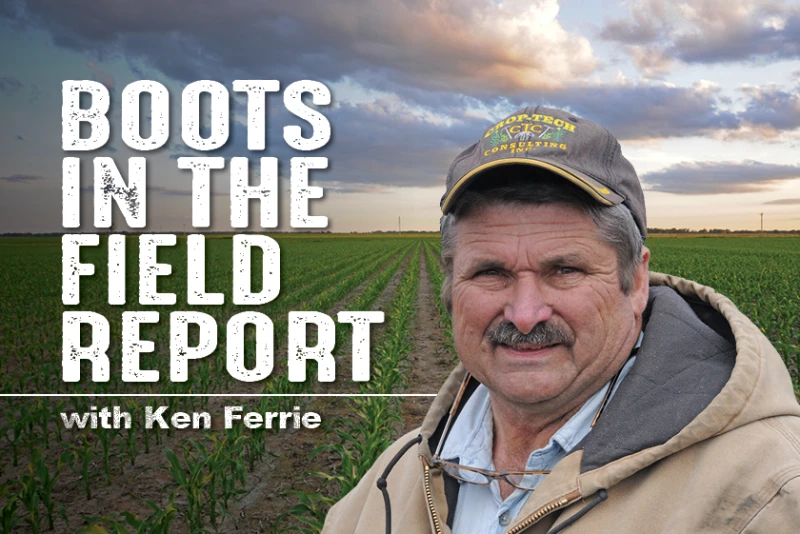
Disease pressure is ramping up in central Illinois corn but the crops have widely varying degrees of infection, according to Ken Ferrie, Farm Journal Field Agronomist.
The biggest issues area growers are dealing with now are tar spot, southern rust and some northern leaf blight. Some farmers are responding by making a second fungicide application, while others are sitting tight, given the tough economic climate.
Understanding it’s a tough call on whether a fungicide application will pay for itself, Ferrie tells growers to stay the course with their fields and make crop evaluations so they can adjust yield expectations and marketing decisions, if need be.
“I’m out here looking at these fields every day, and each one’s kind of its own surprise,” he says.
Corn Yield Potential Is Still Solid
Ferrie recalls that last season he saw a lot of central Illinois fields come in at harvest with 300-plus bushel yields. That’s not his expectation this season, though he thinks farmers could still see an above-average crop depending on what happens during the next few weeks.
“My highest yield estimate so far this season has been 297 bushels, dividing by 80. So there’s definitely a difference in what we’re yield-checking here in central Illinois compared to a year ago,” he says.
“If we compare it to the five-year average, we’re probably going to be satisfied. If we compare it to last year, we could be disappointed,” he adds.
Check Disease Tolerance Scores By Hybrid
Where hybrids had rain in July, Ferrie is seeing tar spot explode in the ear zone. With southern rust, the disease is more scattered in fields, with some more heavily infected by the disease than others.
Matt Duesterhaus is more concerned currently with southern rust in western Illinois, where he’s based, though he expects tar spot could come on stronger in a couple of weeks. He tells farmers hybrid susceptibility needs to be a consideration in the decision whether to spray a fungicide now.
“Once we get from beginning dent into full dent, it’s pretty hard to make a fungicide pay unless you’ve got a susceptible hybrid, one that makes a lot of its yield in kernel depth. So we’ve got to pay attention to those hybrid ratings,” says Duesterhaus, field research agronomist for Crop-Tech Consulting.
He encourages farmers to check their hybrid scores for tolerance to diseases they identify in their specific fields and then weigh the decision whether to make a fungicide application now.
“The tolerance gives you a starting point on scouting,” Duesterhaus says. “Depending on the tolerance, southern rust can take down one hybrid to where you’ll be picking up [combining] down corn, versus in the next hybrid, it might only be a 10- or 20-bushel hit.”
Along with evaluating disease tolerance in hybrids, Ferrie says to consider whether your hybrids are D hybrids—those that count on depth of kernel fill to get their yield punch.
“Their depth of kernel comes at the end of grain fill — the last half of the 60 or so days after pollination through black layer,” Ferrie explains. “They need to stay green as long as possible and finish the season strong. Many new hybrids are D types.”
Check out Ferrie’s latest episode of Boots In The Field podcast for more agronomic insights and recommendations on how to finish strong this season:
Your next read: Analyst Flags Potential Overshoot in Corn Yield Estimate And Why It Matters



