

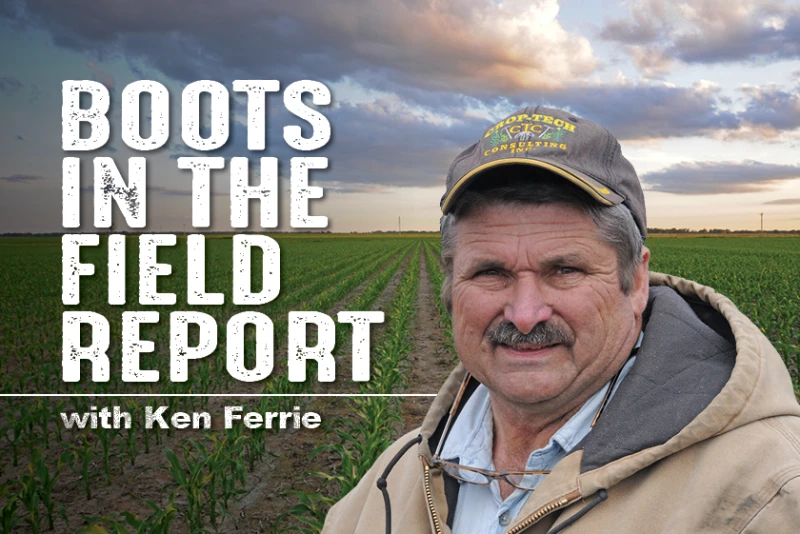
After a week of heavy storms that dumped 4" to 12" of rain across parts of his customer base in Illinois and Iowa, Farm Journal Field Agronomist Ken Ferrie says the good news is farmers’ soil moisture tanks are full heading into late June. The bad news? Ponded corn, emerging disease risks and a narrow window to protect yield potential are also in play.
Ponded Corn: How Long It Lasts And What To Do Next
Ferrie says calls are pouring into his home office from growers regarding corn crops that are standing in water, asking whether they will survive. Duration and temperature, he notes, are the two critical factors for waterlogged corn.
“Corn standing in water for more than 48 hours in these high temperatures is going to get hit pretty hard,” he notes. “Some of this corn is going on four or five days with these back-to-back rains. By mid-week, much of the ponded corn will start to turn silver and die out.”
Regarding soybeans, if a portion of the plant remains above the water level, those plants stand a better chance of survival. However, survival doesn’t mean there isn’t any yield loss. With most soybean fields in the V1 to V4 range across Illinois and Iowa, if soils are saturated for two to three days, yield losses could be up to 50%. Additionally, flooded soybean fields could see reduced nodulation on roots, especially if saturated conditions last longer than seven to 10 days, report Iowa State Extension field agronomists in this article.
Ferrie urges growers to document damage now from above, rather than waiting until harvest results surprise them.
“If you have a drone or access to one, this would be a good time to get a bird’s eye view of where these spots are, how big they are,” he says. “This provides good information when we decide to maybe replant, but it’s also good information for your side-dressing and herbicide teams, so we don’t get an applicator stuck in the middle of the field.”
Replanting Ponds: Beans Over Corn To Cut Losses
When fields finally dry enough to carry equipment, Ferrie believes most of the corn that was ponded will be past the point where replanting corn makes sense economically. For those acres with a herbicide program that will allow soybeans to be planted, that’s what he would advise doing.
Ferrie says those fields will yield more like double-crop soybeans, but they will help farmers manage weeds better and provide some economic benefit, in the process.
He also advises addressing the small, ponded areas, which can become big weed factories if they’re ignored.
“A 2-acre pond can create a lot of weed seed for the weed bank,” he notes. “If the ponds are small and hard to get to, you might give some thought to finding a drone operator who could fly in some cover crop seed for you to help keep those weeds under control.”
Nitrogen Outlook: Mostly Intact, But Watch The Low Spots
Despite the heavy rains, Ferrie says nitrate tests so far show this season have been “nitrogen friendly” in most well-drained fields. The upper 12 inches of soils are carrying most of the nitrates, and he believes recent rainfall will push them into the second 12 inches.
“This rain will push the nitrates into that second foot, but this corn is tall enough to catch it,” he says.
The main concern, he adds, is uneven leaching across whole fields with concentrated losses in low-lying, concave areas where water has stood.
“If you have good drainage and the corn stands survive, these are areas that we’ll need to reassess to see if we’ve got enough nitrogen to carry it to the finish line. We can make that call by pulling nitrates in the near future,” he notes.
He points to 2015 as a reminder to farmers that targeted, late-season nitrogen applications can still pay when June turns excessively wet.
‘This Smells A Lot Like 2021’: Tar Spot Risk Rising
Ferrie says pest teams should brace for an early push of tar spot, especially in those areas that have already seen multiple major rain events.
“The big rains have caused a lot of splash events, where we can get home-grown tar spot splashed up onto the plant,” he says.
A cooler 10-day forecast for central Illinois — with highs in the 70s and lows in the 50s — adds to his concern.
“When I look at the 10-day forecast, it shows a cooling off period, with days in the 70s, nights in the 50s. Guys, this smells a lot like 2021, when here in ‘tar spot alley,’ we had two 100-year rain events back-to-back in a 10-day window, and we were only in the second week of June, and then it cooled off on us. We saw tar spot, the last week in June, at the bottom of the plant,” Ferrie recalls.
So far, the only official confirmation of tar spot for the 2026 season in the Midwest was in Randolph County, Ind., on June 10, according to the Crop Protection Network. You can keep track of where the CPN finds tar spot this season here.
This year, Ferrie is concerned tar spot could show up earlier than southern rust in many Midwest geographies, essentially flipping last season’s pattern. The key to addressing it if it does show up, he says, is advance preparation.
“The good news is we know how to handle this situation. Don’t put your head in the sand and ignore the possibility,” Ferrie advises. “Develop a plan now to handle this potential threat, even if that plan is crop insurance.”
Ferrie addresses additional agronomic issues, including corn rootworm and disease pressure, in his latest Boots In The Field podcast, available at the link below:



