

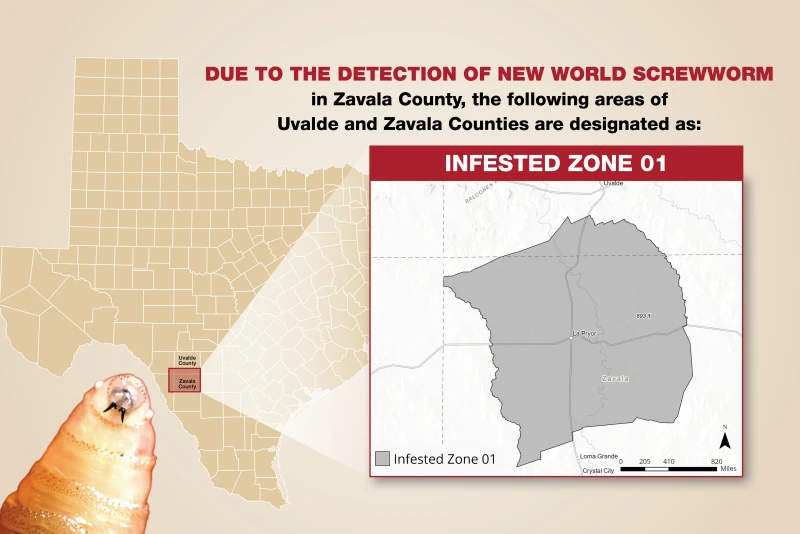
After confirming an infestation in a 3-week-old beef calf, USDA and Texas Animal Health Commission (TAHC) warn animal movement — not fly travel — spreads the pest, and outline inspection, treatment and quarantine steps for cattle producers.
The first case of New World screwworm (NWS) since it was declared eradicated in 1966 has been confirmed on a cow–calf operation in Zavala County near La Pryor, Texas, triggering an aggressive joint response from USDA and TAHC.
Officials stress two key messages: This is not a food safety crisis, and the pest spreads with animals, not by flies traveling long distances on their own. Those points are driving both the regulatory response and what they’re asking producers to do on the ground.
“This pest does not cause any sort of a food safety issue. It is not a disease, but simply an insect that feeds on living tissues,” U.S. Secretary of Agriculture Brooke Rollins stresses. “Animals treated early enough will recover and are safe to enter the food supply system again.”
Dr. Bud Dinges, Texas Animal Health Commission (TAHC) executive director, also confirms: “New World screwworms do not infest meat, fruits, vegetables or other food sources.”
Officials emphasize human-driven movement of animals is the primary risk factor.
“Typically, [it] moves great distances because humans move animals, not because the fly flies to new areas,” Rollins explains.
Immediate Response: Zones, Quarantine and Sterile Fly Releases
USDA and TAHC have created a unified incident command and moved quickly into response mode. To prevent further spread of NWS, TAHC has issued an executive director order that places a quarantine on all warm-blooded animals in the identified infested zone in the Zavala County area.
The order explains: “To protect the health of animals in this state, reduce the spread of NWS to noninfested animals and prevent NWS from establishing in new areas, a quarantine is imposed on the Infested Zone 01. Infested Zone 01 is subject to the following animal movement restrictions:
- Warm-blooded animals located within Infested Zone 01 may not be moved outside of the zone without prior authorization from the Commission. Any person in possession or control of such animals must obtain permission and comply with all conditions set by the Commission before transporting the animals beyond the quarantine boundaries.
- To move warm-blooded animals outside of Infested Zone 01, the animal must be inspected and treated as required by the Commission and issued a permit or certificate for movement by a Commission representative.
- Hides, carcasses, and parts of any animal capable of serving as a host for NWS must be inspected and undergo any treatment deemed necessary by a Commission representative prior to removal from the Infested Zone 01.
- Unauthorized movement is prohibited and subject to administrative penalties and/or criminal prosecution.”
USDA urges producers to contact their veterinarian right away if they see any suspicious wounds, maggots or infestations in their animals or herd. If you see signs of maggot infestations in live or very recently dead wild animals, especially in areas near the U.S.-Mexico border, please call 866-487-3297 to report.
Key steps to the response plan outlined by Rollins include:
- Unified Incident Command and APHIS Deployment.
- 12.4 Mile Infested Zone and Quarantines.
- Sterile Fly Releases – Ground and Air. “We have expedited targeted release of the sterile New World screwworm flies,” Rollins explains including ground release chambers in the area, in addition to the 4 million sterile flies per week already being released aerially in the area.”
- Increased Trapping and Border Surveillance. “We are increasing trapping and surveillance along the border [and] implementing additional surveillance and management strategies in wildlife,” she adds.
Rear Admiral Michael Schmoyer, APHIS associate administrator and NWS Directorate, adds, “USDA has a phenomenal five-person strike team in Texas right now… our boots on the ground, working side by side with our Texas Animal Health colleagues. Since February of this year, we’ve already dispersed over 129 million flies using aerial and ground release chambers, as well as vehicle dispersal methods in Texas.”
Will NWS Confirmation Impact Markets or Demand?
Derrell Peel, Oklahoma State University Extension livestock marketing specialist, says, “Really, this is not going to have much impact on cattle markets and beef markets. We’re not talking about any change in the supply fundamentals. It’s just not going to have that kind of impact, so it’s really not going to have that much market impact.”
He admits NWS is a huge management issue for the producers who are caught up in it, as well as agencies and government trying to deal with it. “It’s very costly, but it’s not an overall market impact. It’s not going to kill very many cattle, if any, it’s not going to change beef production, so it’s just not going [to do] much.”
Glynn Tonsor, Kansas State University professor of agricultural economics, stresses, “First and foremost, I don’t anticipate a beef demand challenge from it. There’s no reason to believe a consumer should be concerned.”
Tonsor says the futures contracts were up today and he predicts that points to the realization the industry is going to have a supply reduction, but we just don’t know how much and for how long.
He summarizes, “It’s just the latest challenge. The cattle industry always has animal health issues; Mother Nature issues; this is just the latest challenge.
“I don’t say ‘been there, done that,’ but there is a part of me that says we navigate this. It doesn’t mean it’s free, but it’s also not the first animal health challenge, so the public and the private industries are set up to navigate it, and I think we will.”
Don Close, senior animal protein analyst with Terrain, says, “We’re not surprised by the immediate market reaction yesterday and the recovery today. The market rally should resume. As drought persists across the western U.S. and the border closure to Mexican feeder cattle continues, cattle numbers will stay stubbornly low.”
Peel adds, “I think the market is so tired [of] waiting for the other shoe to fall, and the uncertainty and the headlines that go along with every announcement that gets made. Now that it’s finally here, I think the market’s kind of relieved — we’ll deal with it.
“The reality is not that much from a market standpoint, so I think that’s part of what you’re seeing — the market’s actually just kind of saying, ‘Okay, we got it, let’s go on, it’s not that big a deal.’”
The Message to South Texas Livestock Producers
Dinges stresses this message to producers and animal owners:
- Report suspicions immediately. “If you suspect your animal may be infested with New World screwworms, notify the Texas Animal Health Commission or your local veterinarian immediately. Quick notification leads to quick detection and quick response.”
- Do not move animals without clearance. “Animals still need to be able to move, we’ll just make sure that they are moving safely and not moving the screwworm with them.”
- Monitor and treat wounds. “Animal owners need to look at their animals as often as possible and stay vigilant, monitoring for wounds that can be covered and treated. This is not an infectious disease, and these flies have to lay their eggs in or near the wound for an animal to become infested.”
- Condition is highly treatable. “We have many tools in our toolkit today to prevent the devastating impacts.”
Did USDA Do Enough?
Rollins and Dinges stress this detection is not for lack of surveillance — if anything, it demonstrates the system working as designed. Rollins reports USDA has deployed more than 8,000 traps along the US-Mexico border and USDA has examined more than 58,000 fly samples and examined more than 19,000 larval samples.
She notes NWS was predicted in Texas a year earlier: “All the models last year showed that the New World screwworm would be in Texas by late summer, early fall of last year. We have been able to successfully keep it out of Texas a year longer, which has allowed us to prepare for today.”
Texas Ag Commissioner Sid Miller disagrees. In a resonse to the confirmed case he criticizes USDA for what he calls a slow, bureaucratic, and incomplete response that allowed the pest to advance unchecked through Mexico and reach American soil.
“For months, the screwworm has advanced rapidly through Mexico in spite of the USDA’s existing gameplan,” Miller said. “Even though billions of sterile flies have been dispersed by USDA, the screwworm has still advanced over 1,100 miles from southern Mexico to Texas, and USDA has missed an important component. Now that it appears the first screwworm has arrived in Texas, the consequences of that decision are now staring us in the face.”
He is urging President Trump to direct USDA to immediately deploy the Screwworm Adult Suppression System (SWASS). In response, Scott Hutchins, USDA under secretary for the research, education and economics, says, “It is important to have a lure and kill a type of technology, but to be an effective technology, it has to have several important attributes. It needs to be a discriminate type of lure. In other words, it needs to attract the screwworm and not every other fly that’s out there. It also needs to have a toxicant that is a modern toxicant and not indiscriminate in and of itself. So, when you look at the technology that you referenced, it doesn’t hit on any of those attributes.”
Production Capacity: Sterile Flies and Long-Term Infrastructure
The long-term eradication strategy hinges on having enough sterile flies to push NWS back south of the Darien Gap.
Rollins outlines research predicts to fully eradicate and begin to push back it will take about 400 to 500 million sterile flies per week.
Current and planned sterile fly production capacity:
- Panama (COPEG) facility: approximately 100 million sterile flies/week, currently operating.
- Metapa, Mexico facility: “This production facility will provide an additional 60 to 100 million sterile flies a week and expected to begin producing in June.”
- Moore Air Base, South Texas facility: “When this facility is fully operational, it will have the capacity to produce 300 million sterile flies per week… expected to be operational in the fall of 2027.”
Companion Animals and Wildlife: Not Just a Cattle Issue
NWS can affect any warm-blooded animal, including wildlife and humans, and adult flies can travel up to 12 miles, so reporting channels exist for livestock, wildlife, pets and people alike.
“This is not just a livestock issue, is not just a cattle issue, it is a pet issue as well… many of those [Mexican cases] were feline, cats and dogs,” Rollins says.
USDA has deployed trained detector dogs to border crossings to monitor pets entering the U.S.
Industry Response to Confirmed NWS in the U.S.
A broad coalition of cattle, farm and wildlife organizations — Texas & Southwestern Cattle Raisers, Texas Cattle Feeders Association, Texas Farm Bureau, Texas Wildlife Association, National Cattlemen’s Beef Association, R-CALF USA, U.S. Cattlemen’s Association and the Meat Institute — have responded to the confirmation with a consistent message across three themes:
- Not a food safety concern. Every organization emphasized this point clearly and repeatedly. Meat and poultry products are safe to consume, and USDA/FSIS inspection protocols at packing plants remain in place.
- Shift from prevention to eradication. After 18-plus months of preparedness work — expanded sterile fly production, increased surveillance, and established treatment protocols — the focus now moves to active eradication, mirroring the successful campaign of the 1960s.
- Call to action for producers and the public. The ask is consistent across groups: monitor livestock and wildlife closely, maintain veterinarian relationships and report suspicious wounds immediately.
Bottom Line for Producers and Animal Owners
The message from USDA and Texas officials is vigilance, cooperation and confidence. This is serious but manageable with early detection, strict movement controls and treatment. Be sure to utilize the USDA’s NWS Response Playbook.
Don’t forget:
- Inspect animals frequently for wounds and larvae.
- Report any suspect cases immediately.
- Comply with quarantine and inspection requirements before moving animals.
- Work closely with your veterinarian on labeled, approved products.
Rollins summarizes, “My goal is over-communication. Make sure you have everything you need to report back to the people, and to ensure that we’re getting the word out.”




