

As June revs up, corn and soybean crops are mostly planted in central Illinois with some limited replanting still underway for both.
Ken Ferrie says most of the corn replanting there is due to the crop having been underwater or covered from the dust storm that went through the area recently.
Soybean replanting has resulted from a variety of factors including hail, crusting soils, herbicide damage, standing water and the dust storm. The good news is that in most cases, there are just partial fields or areas in fields where replanting is needed.
“Overall, I’m seeing really good stands of both corn and beans,” says Ferrie, Farm Journal Field Agronomist. “When corn jumps out of the ground in five to seven days, you end up with really nice, uniform, full stands. While this spring has been a little bit of a struggle, I am enthused about the potential that I’m seeing out there.”
At this point in the season, there are three things he says area farmers are contending with in the field: pests, nitrates, and what he describes as the elephant in the room – soil erosion.
More Soil Stewardship Needed
Ferrie says 2024 will go down as one of the toughest years he has seen in some time, when it comes to erosion resulting from water and wind.
“Most all fields have some erosion, no matter the program, but many fields just have too much,” he says. “No doubt the serious erosion is in the tillage fields. Sheet and gully erosion behind these 2" and 4" downpours on spring tillage is just unacceptable, guys. We need to step up our efforts to stop this.
“If you had to take a field cultivator out and work a draw twice this spring – the same draw – you need a waterway, or you need to change your approach to how you farm that field to prevent ‘gully erosion,’” he adds. “This spring has highlighted the areas that need to be protected.”
One option to handle this issue is to create farmable waterways in those fields.
“This fall, you can seed those areas to cereal rye, lift your tillage tools when you go across them, and burn them off next spring and plant right through them. A few years of doing that will improve things a lot,” he says.
Fields that are flat are less susceptible to gully erosion but are more subject to wind erosion, if they have no residue cover. What is occurring in many cases is spring tillage behind high-speed disks is turning the seedbed to powdery soils. The wind then blows across those fields and creates dangerous dust storms.
“Some of these gullies in fields will be dangerous for sprayer operators trying to do late-season Y-dropping or fungicide applications,” Ferrie says. “Some of these fields should be shifted to air applications, just for the sake of safety.”
The ongoing, heavy rain events and high winds indicate that soil erosion risks aren’t going away anytime soon.
“As you evaluate every field, I’m asking all of you to step up your stewardship. Some of you need to do a little tweaking, some of you need to rethink your whole system,” Ferrie says. “I’m sorry for that rant, and I’ll get off my soapbox. In case you’re wondering how I feel about erosion, now you know.”
The Ugly Corn Phase Arrives
Recent heavy rain events are showing up in many fields, appearing as nitrogen (N) leaching.
“This N is moving down into the soil, and the good news is it’s still in the soil – at least until the next couple of big rains – but it’s not within reach of the small corn,” Ferrie says. “That’s especially true if it’s dealing with the carbon penalty from corn-on-corn or cover crop. We’re seeing this in some fields as the crop enters the ugly corn phase.”
G and L1 hybrids will be the hardest hit in fields, if they are caught in the ugly corn phase. He adds that once the corn roots grow deep enough to access the nitrogen, the crop will improve in color.
One farmer asked Ferrie whether it would be good to Y-drop corn, and whether that would move the crop through the ugly phase faster than making an N injection with a coulter in the middle of the row. The short answer, Ferrie replied, is yes.
“But with small corn, you have to go really slow to avoid splashing N on the corn and burning it,” he says.
“This is one reason why banding N near the row gives you weather protection,” he adds. “A band of N near the row can carry that corn to waist high, giving it time to set deeper roots and be into that nitrogen that’s down there.”
Despite some concerns about nitrogen availability to the crop currently, Ferrie says he agrees with farmers who have good stands and are, therefore, bumping up their yield goals.
“The uniformity of these fields is just outstanding, which we’re seeing as we’re out there looking at them,” he says.
On the flip side, he says to not lower your yield goal automatically in those fields that have some replanted areas.
“While you may have reduced the yield in 5 acres of replant out of 80 acres, which in turn lowers the field average, keep your yield goal set to the 75 acres of your good stand,” he advises. “You only lower yield goal when the corn stand in general has issues.”
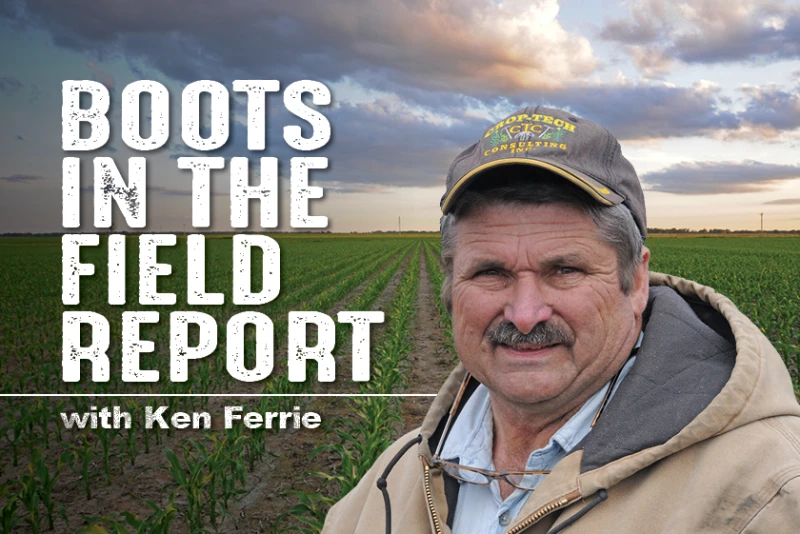
Ferrie offers some additional thoughts and insights on corn nutrient needs and pest concerns at this point in the season in his Boots In The Field podcast, available below.
What To Know From The Biden Administration’s New Carbon Policy Statement
How to Adjust Your Fertility Practices for No-Till and Cover Crops



