
News
Today’s agriculture headlines and expert perspectives serving farmers, ranchers, crop consultants, livestock nutritionists and the entire U.S. ag community.

USDA expects to announce payment rates for its $1B specialty crop aid in a few weeks after closing acreage reporting, which will determine how relief is distributed across eligible crops.

As inventory thins, well-maintained used units are seeing double-digit price increases compared to last year.

With cold, wet weather moving across parts of the Corn Belt, agronomists advise farmers to be ready to check high-yielding genetics for crown and stalk rot.

Ag Secretary Brooke Rollins says a multi-agency Trump administration effort will target fertilizer costs and boost U.S. production, with a major announcement expected yet this week.

Centuro A-PRO is a more concentrated formulation of the original Centuro, containing a higher concentration of the active ingredient, Pronitridine.

Operating on negative margins and facing a “next-generation crisis,” a group of row-crop growers urges the U.S. Supreme Court to follow science over emotion as it hears oral arguments in the Monsanto v. Durnell case on Monday.

This ranks as the fifth worst crop in history and it’s mainly tied to the fact 68% of the crop is in some level of drought. For Kansas, it could be as bad as 2023.

Farm Journal Field Agronomists are launching the 2026 season, planting fields and starting to test the soybean innovations and management strategies that will deliver answers and insights farmers need.

New state laws and a county-wide broadband network are turning science fiction into reality, allowing autonomous tractors and drones to revolutionize the nation’s leafy green production.

To raise your total farm yield average, Connor Sible recommends starting the planting process in your lower soil-testing fields, once they’re fit, and then transitioning to planting higher soil-testing ground.

According to a letter sent to landowners and leasing partners, President Darrel Monette says this process will allow them to stabilize finances, restructure debt, and continue operating.

Sponsored
Damping-off can wipe out young cotton stands fast. Identify common seedling diseases and reduce risk before planting.

Two Midwest growers say increased competition between corn and soybeans for acres could help rebalance supplies and provide a financial boost.

Farm Journal Field Agronomist Ken Ferrie explains how to optimize hydraulic downpressure and closing systems to achieve uniform emergence, picket-fence stands and maximum yield across every soil type and condition.

It can take a few days to assess actual damage results following a frost. Ferrie offers four recommendations on how to do your initial evaluations.

Sponsored
Cotton pests can impact yield and fiber quality. Learn how IPM strategies help growers protect crops all season long.

Industry leaders shed light on the reality of the 45Z tax credit and how it is already reshaping supply sheds.

Perfectly preserved and pickled for 100 years, who was the woman found in red velvet on a Mississippi Delta farm?

New tractor sales across all segments are down 8.8% in the first three months of 2026, but auction data shows a growing 12.5% price increase for specific late-model used tractors.

Tim Webster and Steve Crothers share their cropping plans, telling Ken Ferrie they hope to bounce back this season from record low rainfall and extreme heat in 2025.

A Farmer’s Keeper survey of 4,000 farmers shows 20% are cutting corn acres as record fertilizer prices and supply gaps force last-minute shifts toward soybeans and other crops to protect profitability.

Illinois grower Stephen Butz is uber-focused this season on removing the hidden barriers that have kept his bean crops from reaching their true potential.

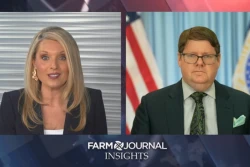
In a candid conversation with Farm Journal, USDA Deputy Secretary Stephen Vaden says USDA’s message to fertilizer companies is simple: “Be part of the solution, don’t be part of the problem.”

Temple Rhodes explains how moving away from front-loaded fertilizer use to what he calls a “layered, systematic approach” — using nitrogen, phosphorus and biologicals — is helping him build corn yields despite increased regulatory demands.

By slashing planting time from weeks to just five days, Clayton Griffith’s switch to no-till aims to ensure sustainability while navigating the challenges of Alaska’s short growing season.

Four ways artificial intelligence helps these farmers manage their business.

Research shows skipping the right tank-mix partner can reduce control of tough broadleaf weeds and grasses by 25% to 90%.

Sponsored
Sulfur deficiency can be tricky to spot. Here’s how to diagnose and protect yield.

A father-son duo turned a 3D-printed project into an autonomous solution that levels grain and breaks up crust in grain bins.